

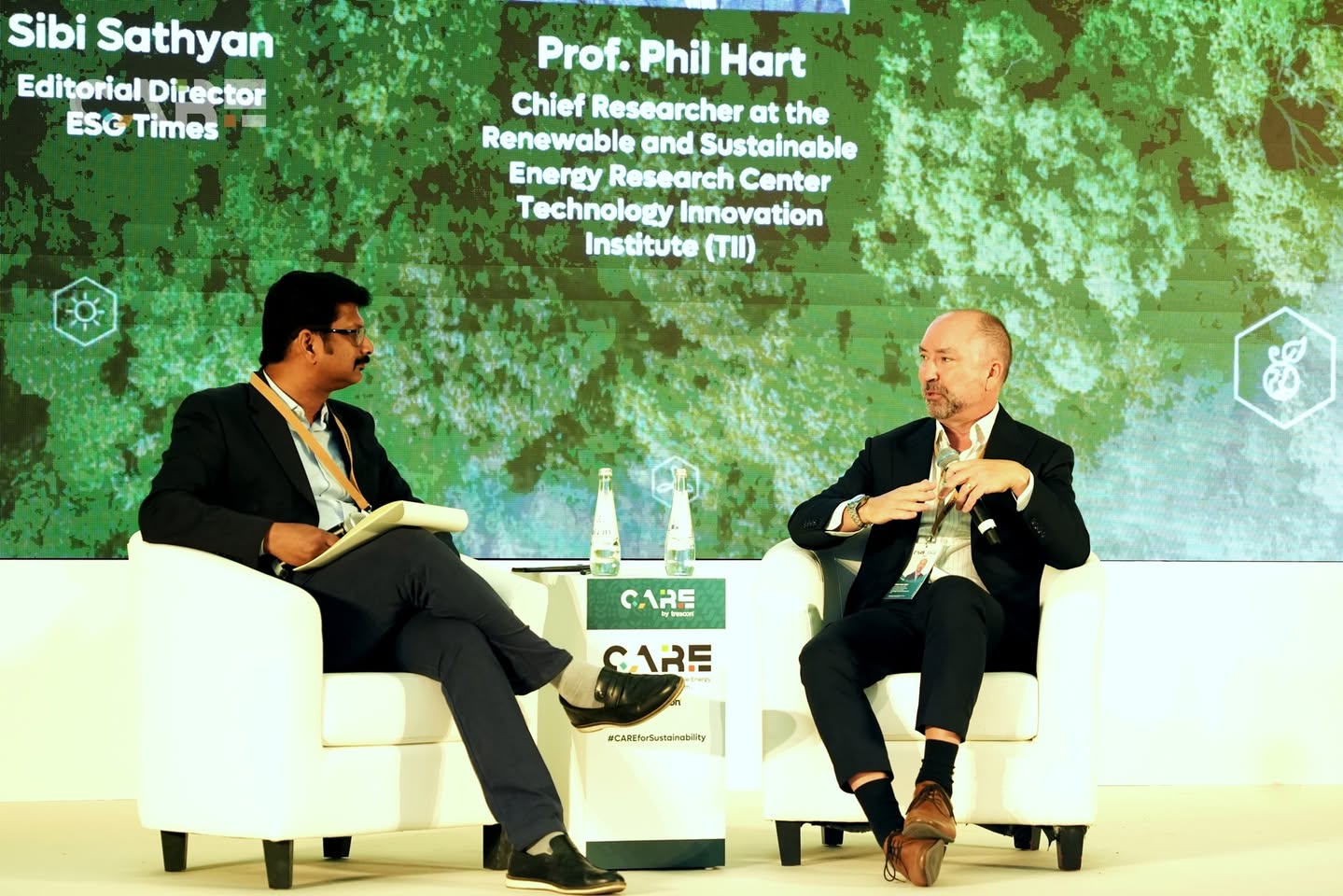
Dubai, UAE — At CARE MENA 2025, one of the most technically rich and strategically urgent conversations unfolded during a session exploring the region’s path to net-zero energy systems.
Prof. Phil Hart, Chief Researcher at the Renewable & Sustainable Energy Research Center at the Technology Innovation Institute (TII), and Sibi Sathyan, Editorial Director at ESG Times, addressed a critical truth:
Data may guide decisions — but transforming an entire energy system requires coordination, investment, and system-wide readiness.
The Core Challenge: Demand Is Surging, Systems Are Straining
As the MENA region accelerates renewable deployment, utilities face a dual challenge:
- Explosive demand growth, driven by population, industrial expansion, and urbanization
- Pressure to decarbonize, modernize, and meet net-zero commitments
The panel made it clear that while solar and wind capacity are scaling rapidly, infrastructure and integration are not keeping pace.
Key bottlenecks discussed included:
- Grid stability under high renewable penetration
- Energy storage limitations that hinder round-the-clock reliability
- Demand-side management gaps, especially in cooling-heavy environments
- Workforce transition and technical capacity needs
- Policy and investment misalignment slowing deployment timelines
Technology Spotlight: Hydrogen, Storage, and Next-Gen Systems
Prof. Hart shared insights from TII’s research on emerging technologies poised to reshape the energy sector:
- Next-generation battery systems with higher density and longer lifecycles
- Hydrogen integration pathways for heavy industry, mobility, and long-duration storage
- Advanced modeling and simulation tools that optimize grid and generation planning
- Hybrid renewable systems capable of supporting multi-sector decarbonization
His message was clear: the technology is ready — but implementing it at national scale requires synchronized action and policy clarity.
Policy, Coordination, and Capital: The Missing Links
Sibi Sathyan emphasized the non-technical barriers slowing the transition:
- Inconsistent or lagging regulatory frameworks
- Limited incentives for utilities to transition faster
- Large capital requirements competing with short-term financial pressures
- Insufficient cross-border collaboration
- Lack of unified national roadmaps connecting industry, regulators, and consumers
Together, these issues highlight why rapid renewable progress doesn’t automatically equal system transformation.
The Reality Check: Energy Transition Is a System, Not a Single Technology
The panel reached a decisive conclusion:
Renewable energy alone does not create a net-zero system. It must be paired with coordinated planning, investment, regulation, and consumer engagement.
As CARE MENA 2025 continues, this session stands out as a reminder that the region’s energy transition will be defined not only by technological breakthroughs — but by the operational and governance coherence that brings them to life.
More insights coming from CARE MENA 2025.
Learn more: careforsustainability.com
#CARE2025 #CAREMENA #EnergyTransition #RenewableEnergy #NetZero #CleanTech #Hydrogen #EnergyStorage #GridStability #ClimateAction #Dubai