
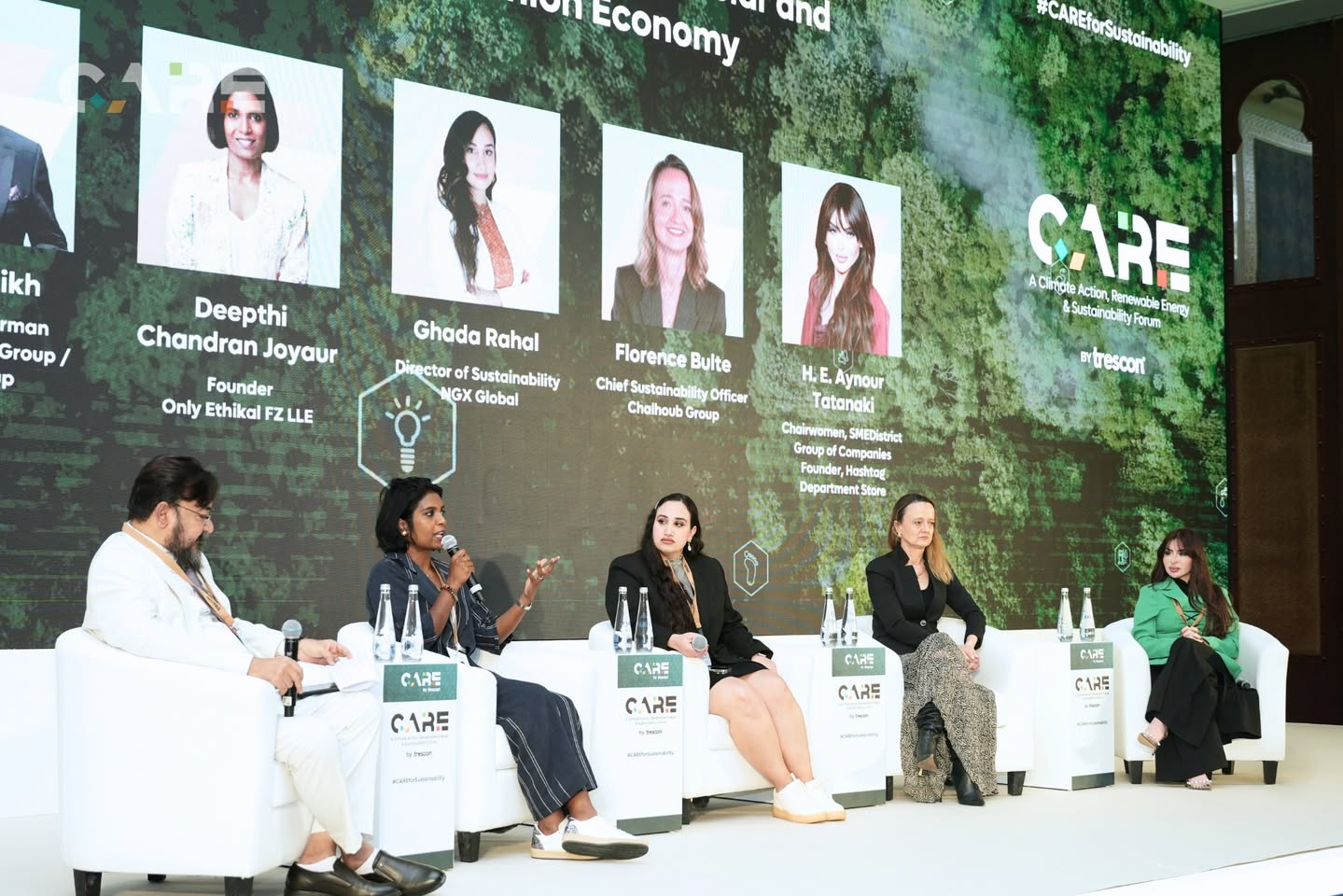
Dubai, UAE — Fashion sits at the center of retail’s sustainability challenge — responsible for nearly 10% of global emissions, while only 12–15% of clothing ever gets recycled. At CARE MENA 2025, a powerhouse panel brought clarity to what it will take to shift one of the world’s most resource-intensive industries toward a truly circular future.
The session featured diverse leaders spanning ethical startups, luxury retail, large-scale distribution, and innovative business models:
- Deepthi Chandran Joyau — Founder, Only Ethikal FZ LLE
- Ghada Rahal — Director of Sustainability, NGX Global
- Florence Bulté — Chief Sustainability Officer, Chalhoub Group
- H.E. Aynour Tatanaki — Chairwoman, SMEDistrict Group of Companies & Founder, Hashtag Department Store
Moderated by Hanif Shaikh, Founder & Chairman, Emirates Holding Group / United Group, the discussion confronted the industry’s toughest realities — and its biggest opportunities.
What Circular Fashion Really Requires
The panel moved beyond slogans to outline the structural changes needed to build a circular fashion ecosystem:
1. Redesigning Products From the Start
Durability, repairability, and recyclability must be engineered into garments at the design phase — not added as afterthoughts.
2. Building Reverse Logistics at Scale
Fashion needs systems that can collect, sort, repair, resell, and recycle garments — efficiently and profitably.
3. Educating Consumers
Shifting consumer behavior is foundational:
- Care instructions impact lifespan
- Repair culture reduces waste
- Knowing end-of-life options increases circular recovery rates
4. Reinventing Business Models
The panel emphasized a major industry shift:
Profit must come from product longevity, not disposability.
This includes resale, rental, repair, subscription models, and sustainable lines aligned with the circular economy.
A Shared Conclusion: Fast Fashion’s Model Is Losing Resilience
While fast fashion has dominated for two decades, its underlying economics are showing cracks:
- Volatile supply chains
- Rising regulatory pressure
- Consumer shifts toward responsibility
- Higher waste-management costs
- Increasing scrutiny over social and environmental impact
The panelists agreed:
Circular fashion isn’t a niche movement — it’s a competitive advantage waiting to scale.
Brands that adopt circularity early will gain resilience, loyalty, and regulatory readiness, while those clinging to volume-based models risk long-term decline.
CARE MENA 2025 continues to highlight how sectors across the MENA region are rethinking their systems, models, and value chains to meet the demands of a sustainable future.
More insights: careforsustainability.com
#CARE2025 #CAREMENA #SustainableFashion #CircularFashion #RetailInnovation #CircularEconomy #ResponsibleBrands #Dubai #ClimateAction #GreenRetail