
Dubai, UAE — At CARE MENA 2025, leaders from healthcare, real estate, technology, and industrial sectors converged to address one of the most pressing challenges in global sustainability: reducing emissions from the built environment, which today accounts for nearly 40% of global greenhouse gas emissions.
In a high-level panel discussion, experts explored how the next generation of buildings — hospitals, commercial complexes, urban districts, and industrial facilities — are being transformed through smart technology, sustainable architecture, and advanced automation.
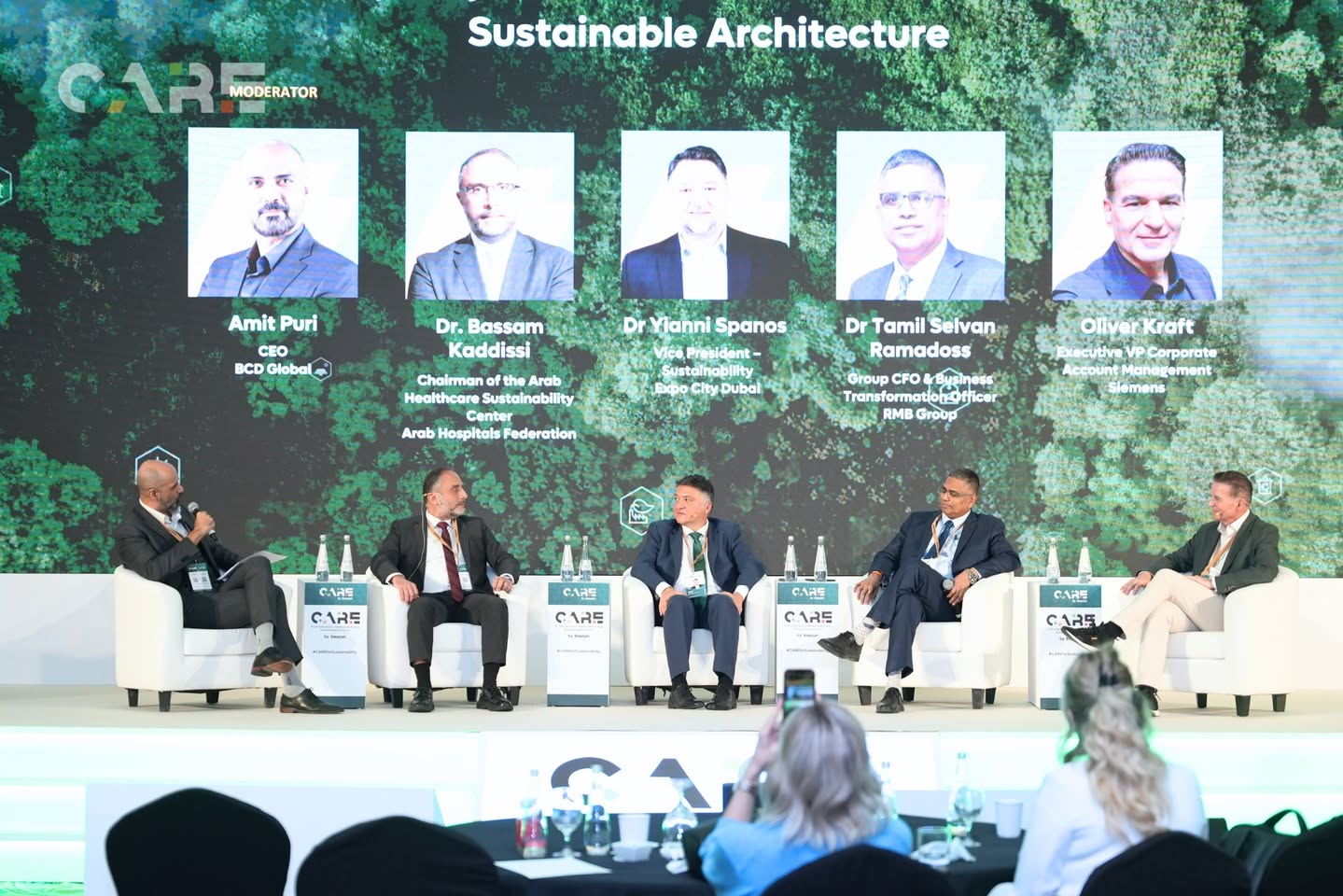
Participants included:
- Dr. Bassam Kaddissi — Chairman, Arab Healthcare Sustainability Center, Arab Hospitals Federation
- Dr. Yianni Spanos — Vice President of Sustainability, Expo City Dubai
- Dr. Tamil Selvan Ramadoss — Group CFO & Business Transformation Officer, RMB Group
- Oliver Kraft — Executive Vice President, Corporate Account Management, Siemens
The conversation was moderated by Amit Puri, CEO of BCD Global.
A New Era of Smart, Sustainable Infrastructure
The panel highlighted how diverse sectors are integrating intelligent technologies and climate-aligned design to reduce emissions, improve operational efficiency, and enhance human well-being.
Healthcare Facilities
Dr. Bassam Kaddissi emphasized the shift toward:
- Green hospital design
- Efficient energy systems
- WELL and LEED certifications
- Improved indoor environmental quality for patient outcomes
Urban Developments
Dr. Yianni Spanos shared Expo City Dubai’s transformation into a living sustainability laboratory, where smart infrastructure, green mobility, and closed-loop systems are being implemented at district scale.
Industrial Complexes
Dr. Tamil Selvan Ramadoss discussed how industrial automation is reducing energy use, optimizing processes, and cutting emissions across manufacturing sites and industrial zones.
Citywide Building Intelligence
Oliver Kraft outlined how integrated Building Management Systems (BMS) and IoT-enabled solutions — from HVAC optimization to adaptive lighting — are making entire districts smarter and more efficient.
Buildings Are No Longer Static — They Are Learning Systems
One of the most powerful insights from the session was the redefinition of buildings themselves:
“Buildings aren’t static assets anymore. They’re intelligent systems that learn, adapt, and optimize in real time.”
With AI-enabled monitoring, digital twins, predictive maintenance, and occupancy-based automation, buildings are evolving from passive structures into active contributors to sustainability goals.
A Transformational Opportunity for the Region
The MENA region is experiencing rapid urban growth, creating a rare opportunity to deploy smart building technologies at scale — from hospitals and mixed-use communities to logistics hubs and industrial campuses.
The session made clear that the future of net-zero infrastructure will depend on:
- Technology integration
- Climate-aligned design
- Cross-sector collaboration
- Digitally empowered operations
CARE MENA 2025 continues to highlight how sustainability is reshaping every aspect of the built environment — and why intelligent infrastructure is central to achieving national climate goals.
More insights at: careforsustainability.com
#CARE2025 #CAREMENA #SmartInfrastructure #GreenBuilding #SustainableArchitecture #NetZeroBuildings #UrbanInnovation #ClimateAction #Dubai #SustainabilityTech #SmartCities