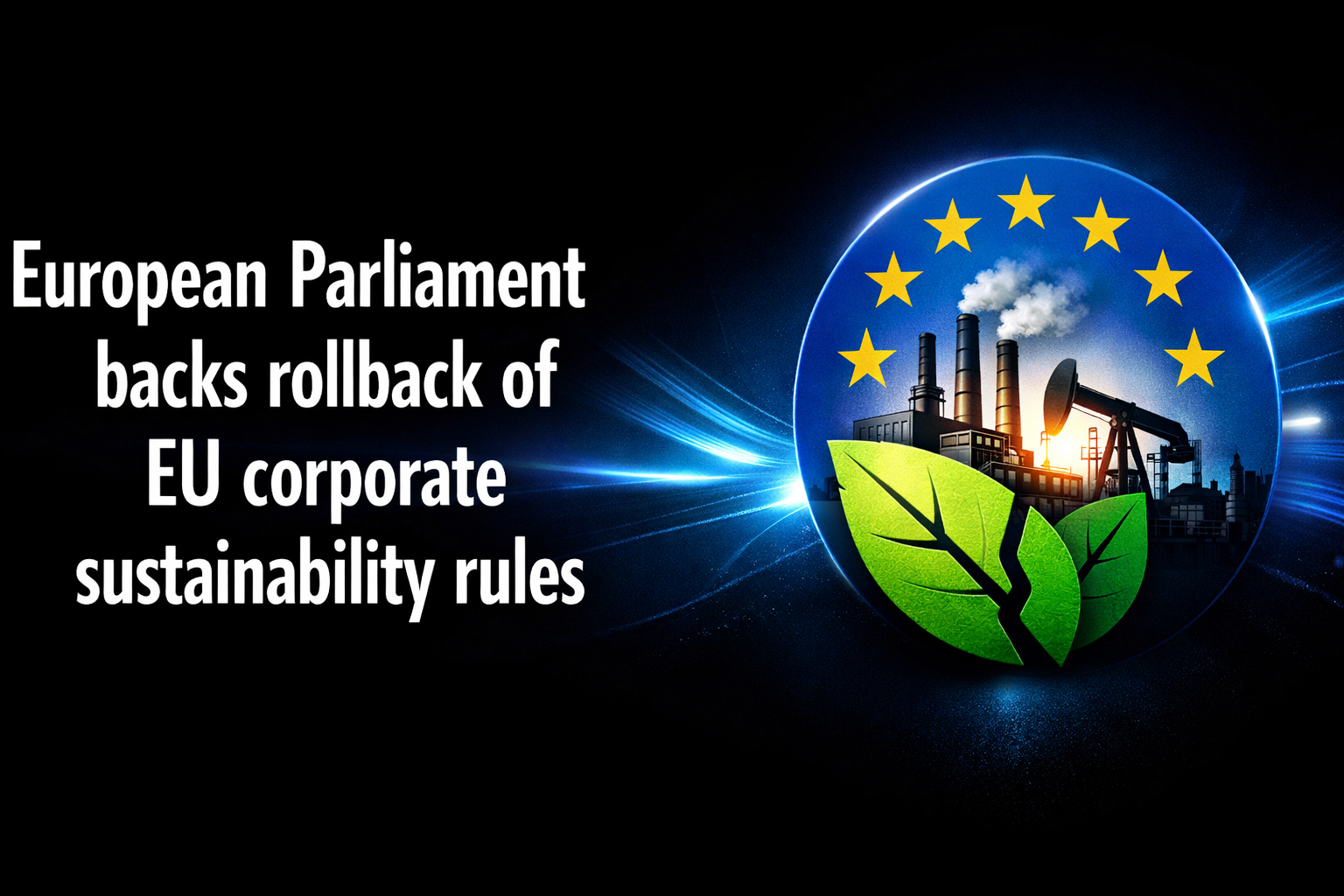
The European Parliament has voted to scale back two flagship EU laws designed to force companies to disclose sustainability risks and police abuses in their supply chains, approving a deal that sharply narrows the number of firms caught by the requirements.
MEPs endorsed the package in Strasbourg on 16 December 2025 by 428 votes to 218, with 17 abstentions, completing Parliament’s final legislative step on the file. The changes are expected to receive formal sign-off from member states in early 2026, after which the amended rules can enter into force.
The vote covers revisions to the Corporate Sustainability Reporting Directive (CSRD) and the Corporate Sustainability Due Diligence Directive (CSDDD, often referred to in Brussels shorthand as CS3D). Both measures were agreed during the EU’s previous legislative cycle as part of a broader push to standardise corporate reporting on environmental and social impacts and to require companies to address harm linked to their operations and value chains.
Higher thresholds, narrower scope
Under the deal approved by MEPs, the CSRD’s reporting obligation is refocused on larger companies. The revised scope applies to EU companies with more than 1,000 employees and net annual turnover above €450 million. Equivalent thresholds are applied to non-EU companies through EU turnover, with additional conditions linked to branches or subsidiaries operating in the bloc.
For supply-chain due diligence, the agreement limits the CSDDD to only the biggest corporate groups. The threshold is set at more than 5,000 employees and €1.5 billion in annual turnover, with the same test applied to non-EU companies based on EU turnover. Companies covered by the directive face potential financial penalties for non-compliance, with a cap of up to 3 per cent of net global turnover under the revised approach.
The changes remove a requirement that would have compelled companies to produce and implement climate transition plans as part of the due diligence framework, according to reporting and contemporaneous commentary on the deal.
Timetable shifts
The agreement also pushes back implementation of the due diligence regime. Reporting around the vote indicated that the revised application date for the largest companies is delayed until 2029.
The Council of the EU, which represents member states, said earlier this month that the provisional agreement was intended to reduce administrative burden and limit “trickle-down” effects on smaller suppliers that can be asked for data by larger corporate customers.
Why the EU changed course
The rollback follows an EU-wide political drive to cut regulatory costs amid concerns about growth, investment and industrial competitiveness. In February 2025, the European Commission proposed a “simplification omnibus” that included lifting the CSRD employee threshold from 250 to 1,000 — a shift the Commission estimated would reduce the number of companies in scope from about 50,000 to around 10,000.
Supporters of the scaled-back regime argue that the original rules were too broad, complex and expensive to implement, particularly for mid-sized businesses that were preparing new reporting systems to comply with detailed European Sustainability Reporting Standards.
Critics, however, say the narrower scope will reduce the volume of comparable information available to investors, regulators and civil society, making it harder to identify firms that are managing climate and human-rights risks effectively. Reuters reported earlier this month that investors and sustainability specialists expect more of the burden to fall on market participants to scrutinise corporate claims, as the formal reporting net is tightened.
Reaction divides along familiar lines
Environmental and human-rights organisations criticised the Parliament vote, arguing it weakens oversight and reduces the EU’s leverage over supply-chain practices. The Guardian reported that groups described the move as a retreat from earlier commitments and highlighted the higher thresholds and delayed due diligence timeline.
Business and industry bodies have broadly welcomed simplification, while cautioning that companies operating across borders will still need clear guidance, consistent enforcement and workable standards to avoid fragmented national approaches once implementation resumes.
With member-state approval expected in early 2026, attention is likely to shift to how the revised directives are implemented in practice, including the detail of guidance, supervisory expectations and the extent to which large firms continue to demand sustainability data from smaller suppliers even when the latter are formally outside the scope of EU reporting law.
Source: https://eutoday.net/