
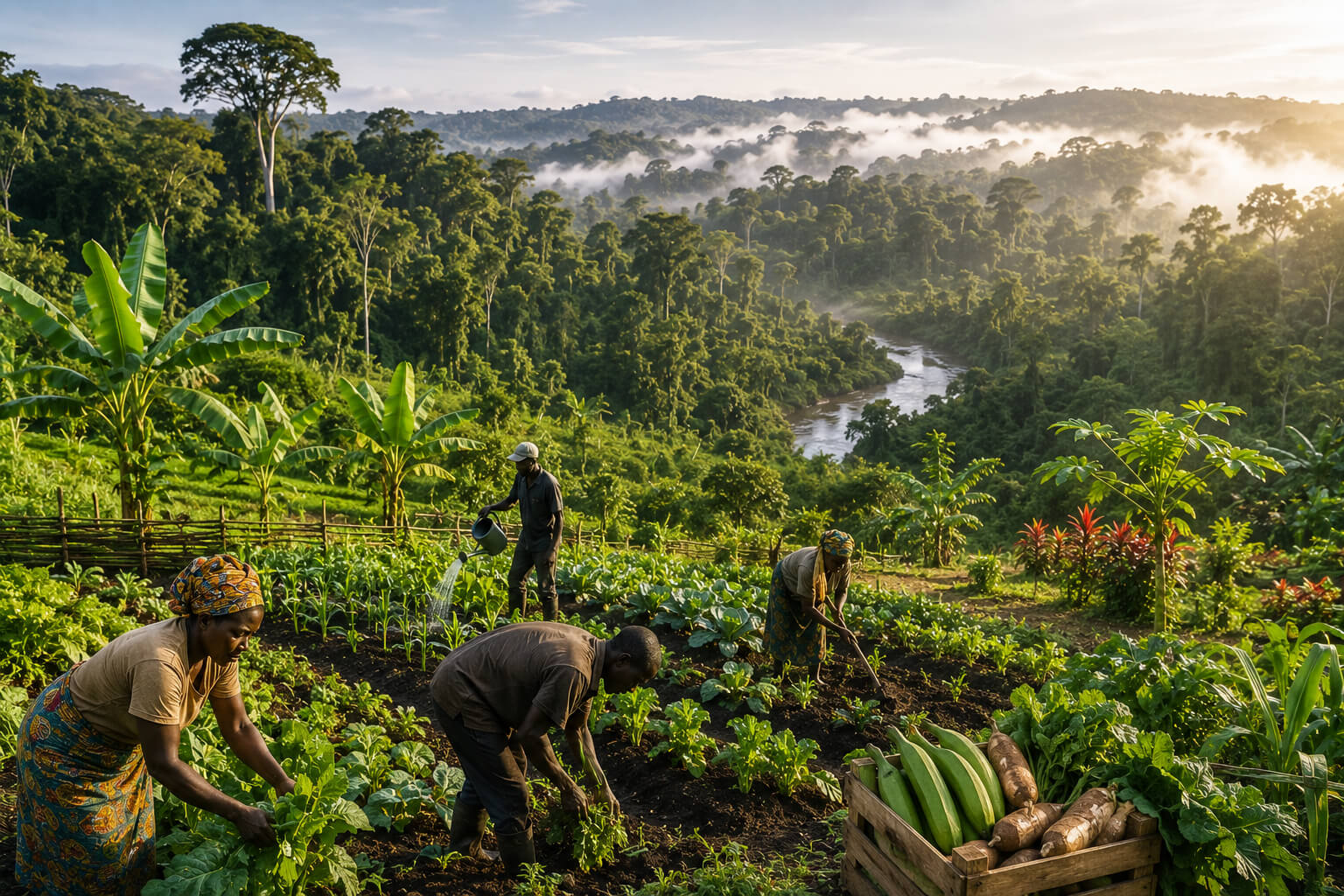
Congo Basin governments are facing a difficult balancing act. They need to produce more food for growing populations while avoiding further damage to one of the world’s most important tropical forest systems.
Six countries at the heart of the Congo Basin have now backed a regional push to expand agroecology, placing sustainable farming, biodiversity protection and food security within the same policy framework. The move was formalised through the Yaoundé Declaration 2026, adopted during the Second Congo Basin Convening in Cameroon from August 25 to 27.
The gathering brought together government representatives, farmers, Indigenous Peoples, researchers, civil society organisations and development partners. It ended with a 24-point declaration focused on agriculture, climate resilience, biodiversity, land rights and financing.
Congo Basin Countries Put Agroecology on the Regional Agenda
Cameroon, Gabon, Equatorial Guinea, the Central African Republic, the Republic of Congo and the Democratic Republic of Congo are among the countries driving the initiative. Their shared problem is increasingly difficult to ignore. Agricultural production needs to rise, yet clearing more forest to create farmland risks weakening the ecosystems that communities and farming systems already depend on.
The Congo Basin contains the world’s second-largest tropical rainforest after the Amazon. Its forests store vast amounts of carbon, influence regional rainfall patterns and support millions of people. They are also home to extraordinary biodiversity. That makes uncontrolled agricultural expansion particularly risky, especially as climate pressures intensify across Central Africa.
The Yaoundé Declaration positions agroecology as one possible answer. Rather than relying solely on conventional agricultural expansion, the approach focuses on healthier soils, crop diversity, local seed systems and farming practices that work more closely with surrounding ecosystems.
The Yaoundé Declaration Comes With Funding Targets
One of the strongest parts of the agreement is its focus on financing. The declaration calls on governments and regional institutions to integrate agroecology into agricultural investment plans and direct at least 30% of relevant food-system budget allocations toward agroecological approaches.
It also proposes that at least 20% of climate and biodiversity financing should reach farmers’ organisations, Indigenous Peoples, women, young people and local communities directly. That matters because sustainable agriculture programmes often struggle when funding remains concentrated at national or institutional level rather than reaching producers on the ground.
The declaration also supports stronger customary land rights, farmer-managed seed systems and the creation of a dedicated regional financing mechanism for agroecology. These measures are meant to give communities more influence over how agricultural and environmental programmes are designed and delivered.
Food Security Is Making the Debate More Urgent
The push toward agroecology is not being driven by environmental concerns alone. Food insecurity across Central Africa is making agricultural reform increasingly urgent, particularly in areas affected by conflict, flooding, high food prices and unstable access to farm inputs.
Cameroon provides one example. Agriculture remains a major part of the country’s economy and supports a significant share of the workforce, yet millions of people continue to face food insecurity. An April 2026 assessment by the Food and Agriculture Organization projected that more than 2.8 million people in Cameroon could experience severe acute food insecurity between June and August 2026, with around 250,000 people expected to face emergency-level conditions.
The Democratic Republic of Congo faces even sharper pressures in several conflict-affected regions. FEWS NET has projected continued Crisis-level food insecurity in parts of Ituri, North Kivu and South Kivu, where insecurity and population displacement have disrupted agricultural production and access to markets.
Agroecology Is Becoming an Economic Strategy Too
Agroecology is often discussed mainly as an environmental approach, but Congo Basin governments increasingly see an economic argument as well. Farming systems that use crop diversity, improved soil management and fewer imported inputs may help small producers reduce exposure to fertiliser price spikes and disruptions in international supply chains.
That could be particularly important for rural communities operating with limited financial margins. When fertiliser, fuel or imported seed prices rise, smallholder farmers can quickly find themselves unable to maintain production. Agroecological practices may offer more locally adapted options, although they still require investment, technical support and access to markets.
Climate resilience is another consideration. Farms with healthier soils, greater crop diversity and stronger local seed systems may be better positioned to handle droughts, flooding and changing rainfall patterns. Agroecology is therefore being framed not simply as conservation, but as part of a broader strategy for agricultural stability.
Protecting the Congo Basin Forest Changes the Equation
The scale of the Congo Basin forest makes agricultural policy in the region globally significant. The rainforest stores enormous quantities of carbon, regulates water systems and supports species found nowhere else. It also underpins livelihoods across rural communities that depend directly on forests, rivers and surrounding agricultural land.
Agricultural expansion can create jobs and increase domestic food production, but poorly managed growth can also accelerate deforestation. Once forests are cleared, the effects can spread beyond the immediate area through soil degradation, reduced rainfall reliability and biodiversity loss.
That tension sits at the centre of the Yaoundé Declaration. Governments want to increase food production, yet they also recognise that long-term agricultural growth will be difficult if the natural systems supporting farming continue to deteriorate.
Farmers and Local Communities Could Gain a Bigger Role
The regional strategy places considerable emphasis on farmers, Indigenous Peoples, women and young people. These groups were represented during the Yaoundé discussions alongside government officials, researchers, civil society organisations and development partners.
Land rights are particularly important in this discussion. Farmers and Indigenous communities are less likely to make long-term investments in sustainable land management when their rights to land remain uncertain. Stronger customary land protections could therefore support both rural livelihoods and forest conservation.
Farmer-managed seed systems are another important element. Locally adapted seeds can help farmers respond to changing climate conditions while reducing dependence on expensive external inputs. The declaration’s support for these systems reflects a wider effort to keep more agricultural knowledge and resources within local communities.
Regional Cooperation Will Decide What Happens Next
The declaration itself will not automatically change farming practices across the Congo Basin. Its real impact will depend on how individual governments translate regional commitments into national programmes, budgets and regulations.
Participating countries are expected to establish or strengthen national agroecology platforms, while organisations such as the Alliance for Food Sovereignty in Africa are supporting regional coordination and resource mobilisation. The challenge will be maintaining momentum once the political attention surrounding the declaration begins to fade.
There are already examples of related work taking place. Cameroon and United Nations partners launched the CONVERGEFOOD programme in March 2026 to improve financing, market access and connections between smallholder farmers and agricultural businesses. Projects in the Democratic Republic of Congo are also exploring ways to improve farm productivity while reducing pressure to push agricultural activity deeper into forest areas.
Congo Basin Agroecology Push Faces Its Hardest Test: Delivery
The Yaoundé Declaration brings food security, climate adaptation, biodiversity and rural development into the same regional conversation. That is important, but implementation will determine whether the agreement produces meaningful change.
Governments will need to convert funding targets into actual spending. Farmers will need financing, training, infrastructure and better access to markets. Land-rights commitments will need enforcement, while climate and biodiversity funds will have to reach local communities rather than remaining concentrated within large institutions.
The direction is still significant. Congo Basin countries are signalling that increasing food production does not necessarily have to mean sacrificing more forest. For a region containing one of the planet’s largest remaining tropical forest systems, finding a workable balance between agriculture and conservation could have consequences far beyond Central Africa.
Sources
African Sustainability Matters — Congo Basin states back agroecology push as food security pressures mount and forest protection imperatives grow
https://africasustainabilitymatters.com/congo-basin-states-back-agroecology-push-as-food-security-pressures-mount-and-forest-protection-imperatives-grow/
Alliance for Food Sovereignty in Africa — The Yaoundé Declaration: The Congo Basin Names Its Price for Change
https://afsafrica.org/blog/the-yaounde-declaration-the-congo-basin-names-its-price-for-change/