
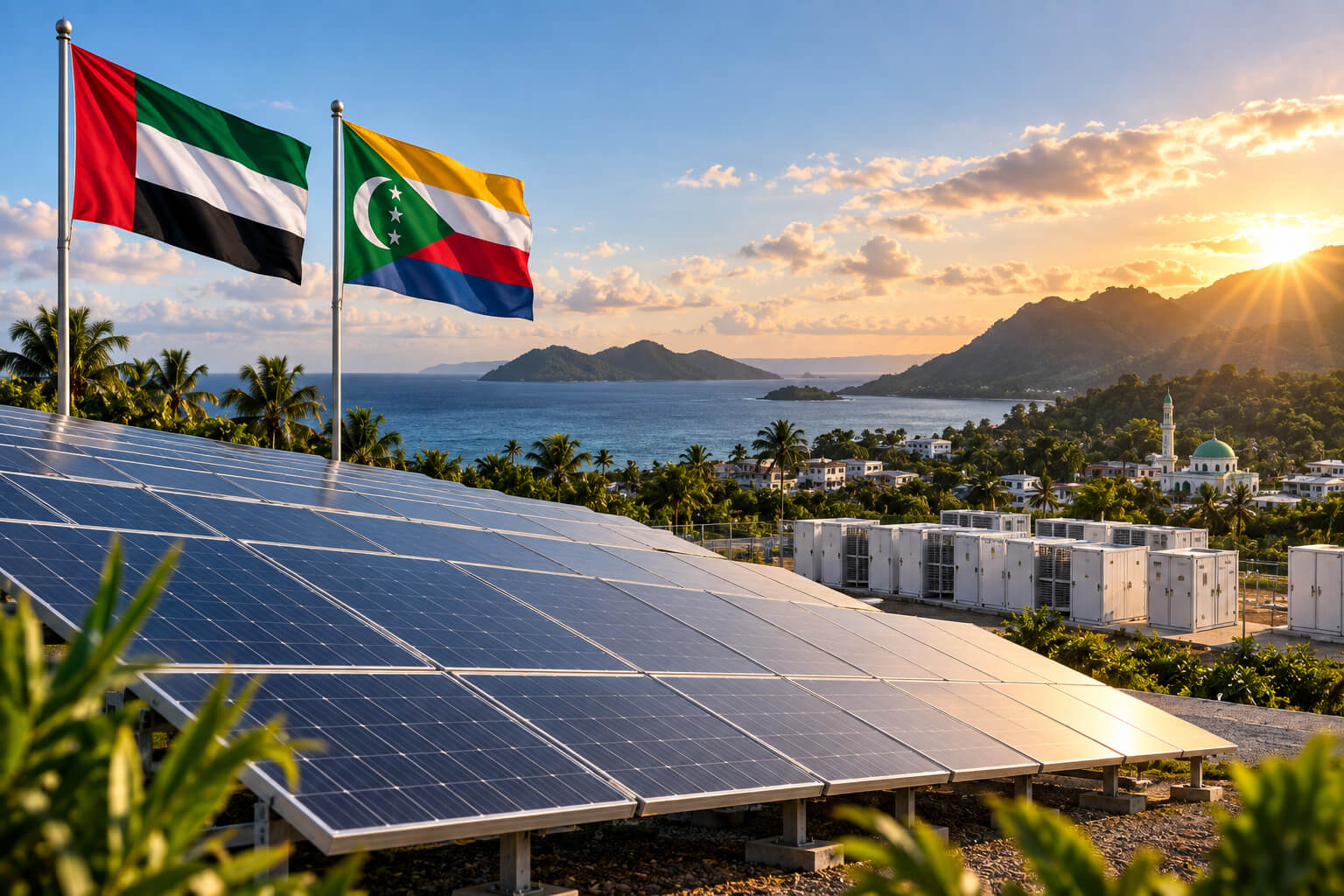
Three new UAE-backed solar power plants have officially opened in Comoros, giving the island nation a significant boost in renewable electricity at a time when its power system remains heavily dependent on imported diesel.
The project adds nearly 20 megawatts of solar capacity across Grande Comore, Anjouan and Mohéli. It also includes battery storage and new transmission infrastructure, making the development more than a simple solar installation.
For Comoros, the timing matters. The country has struggled with electricity shortages, frequent outages and a costly dependence on imported fuel. The new plants will not fix the entire power system overnight, but they give the grid something it badly needs: more locally generated electricity.
UAE Financing Brings Solar Power Across Three Islands
The Abu Dhabi Fund for Development financed the project with approximately AED84.4 million, while Abu Dhabi Future Energy Company Masdar supported its implementation. Global South Utilities will manage the facilities after completion. The project spreads renewable capacity across the country’s three main islands instead of concentrating generation in a single location. Grande Comore hosts the largest plant at 12.86 MW, while Anjouan receives 4.05 MW and Mohéli adds another 3.1 MW.
Comorian President Azali Assoumani inaugurated the facilities alongside officials from Comoros and the UAE. Beyond the diplomatic significance, the project directly addresses a practical problem facing the country: electricity supply has often struggled to keep pace with demand, and adding generation across several islands improves the reach of the new capacity.
Battery Storage Gives the Solar Project More Value
The project also includes 16 megawatt-hours of battery energy storage with around 8 MW of power output across Grande Comore and Anjouan. This matters because solar generation naturally changes throughout the day. Batteries allow part of the electricity produced during strong sunlight to be stored and used later when generation drops or demand rises.
That gives the local electricity system more flexibility and improves the usefulness of the solar plants beyond daylight hours. The project also added roughly 30 kilometres of 20-kilovolt medium-voltage transmission lines, helping move electricity from the new facilities into the local networks.
Solar Plants Could Supply Around 17,500 Households
The three plants are expected to generate around 33.75 gigawatt-hours of electricity each year. Based on project estimates, that is enough to supply approximately 17,500 households with clean power.
The environmental impact is also notable. The facilities are expected to prevent around 20,900 tonnes of carbon dioxide emissions annually. For a small island country, the value of the project goes beyond emissions reductions because every unit of electricity generated locally also helps reduce pressure created by imported fuel.
Comoros Remains Heavily Dependent on Imported Diesel
Imported diesel accounted for around 91% of Comoros’ energy mix in 2024, showing how heavily the country relies on fuel brought in from overseas. That dependence creates obvious risks, including exposure to global fuel prices, shipping disruptions and supply constraints.
The country’s electricity demand reached around 254 GWh in 2024, while actual generation stood at only about 150 GWh. Comoros also experienced roughly 3,000 power outages during the year. Those numbers show why the addition of almost 20 MW of solar capacity carries more weight than the headline figure might suggest.
New Solar Capacity Could Cover a Meaningful Share of Demand
The new plants are expected to provide electricity equivalent to approximately 13.3% of total national demand and around 22.5% of actual generation when compared with 2024 electricity figures.
That is a substantial contribution for a relatively small power system. It also pushes solar from the edge of the energy mix toward a more meaningful role in national electricity supply. Comoros still needs more generation, storage and grid investment, but this project creates infrastructure that future renewable developments can build on.
UAE Expands Its Clean Energy Presence in Emerging Markets
The development also adds another country to the UAE’s expanding international renewable energy footprint. The combination of ADFD financing, Masdar’s renewable energy experience and GSU’s operational role reflects a model increasingly used in markets where access to large-scale clean energy finance can be difficult.
For small island economies, that approach can be especially important. These markets often have good solar resources but relatively small grids, limited infrastructure and high dependence on imported fuel. Renewable projects supported by external financing can help overcome some of those barriers.
Clean Energy Is Becoming an Energy Security Strategy
The larger story in Comoros is not only about sustainability. Renewable energy is becoming part of the country’s energy security strategy.
Solar generation allows Comoros to produce more electricity domestically instead of relying almost entirely on imported diesel. Battery storage improves reliability, while new transmission infrastructure helps distribute that electricity more effectively across the grid.
If the plants reach their projected annual generation of 33.75 GWh, they will become a meaningful part of the country’s electricity supply while cutting emissions and reducing exposure to imported fuel.
Twenty megawatts may seem small compared with massive solar farms being built elsewhere. In a country facing a persistent generation shortage, it can make a much bigger difference.
Sources
Zawya — UAE-backed solar plants inaugurated in Comoros to strengthen energy security
https://www.zawya.com/en/zawya-green/energy/uae-backed-solar-plants-inaugurated-in-comoros-to-strengthen-energy-security-479688
MEED — Comoros inaugurates UAE-backed solar plants
https://www.meed.com/comoros-inaugurates-uae-backed-solar-plants
Technical Review Middle East — Comoros inaugurates UAE-backed solar plants
https://technicalreviewmiddleeast.com/power-a-water/renewables/comoros-inaugurates-uae-backed-solar-plants