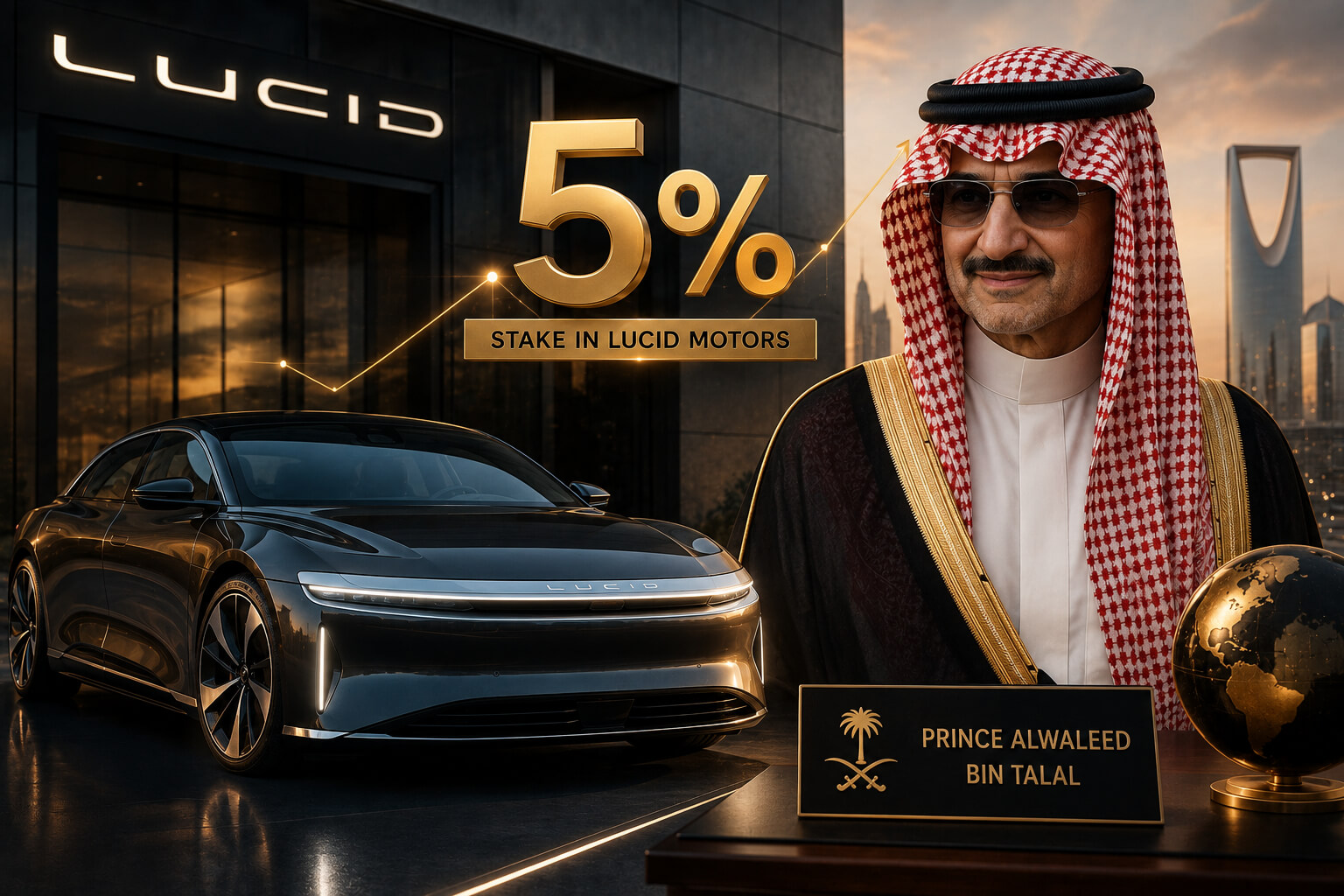
Saudi billionaire Prince Alwaleed bin Talal has taken a 5% stake in Lucid Group, placing another prominent Saudi investor behind the electric vehicle company at a difficult point in its growth story.
The investment covers approximately 19.5 million shares and was disclosed through a filing with the US Securities and Exchange Commission. Reports valued the position at roughly $129.5 million when the disclosure emerged, although its market value moved sharply as Lucid shares rallied on the news.
This is not the same as another investment from Saudi Arabia’s Public Investment Fund. Prince Alwaleed acquired the shares independently, adding a separate layer of Saudi ownership to a company already closely tied to the Kingdom.
The Market Treated the Deal as a Vote of Confidence
Lucid’s share price jumped after investors learned about the stake.
The company’s stock climbed more than 20% during Tuesday trading, with the market apparently reading Prince Alwaleed’s purchase as a sign that influential investors still see value in Lucid’s technology and long-term plans.
That reaction says something about Lucid’s current position. The company does not lack ambition or advanced engineering. What it has lacked is consistent commercial momentum.
Lucid has spent heavily developing its vehicles, expanding production and trying to compete in a premium EV market crowded with established automakers and aggressive newcomers. A large personal investment from one of Saudi Arabia’s best-known businessmen does not solve those problems. It does give the company something it badly needed: a visible show of confidence.
Prince Alwaleed Bought the Stake Independently
The regulatory filing showed that Prince Alwaleed owns 19,513,000 Class A shares, representing exactly 5% of Lucid’s outstanding stock based on the share count included in the disclosure.
The position was reported as a passive investment, meaning the shares were not acquired with the stated purpose of changing or controlling Lucid’s management. Prince Alwaleed also indicated that he bought the stake while Lucid’s market capitalisation was below $2 billion.
That timing matters.
Lucid’s valuation had fallen sharply, creating an opportunity for an investor willing to accept the considerable risks surrounding a cash-intensive EV manufacturer. Buying at a depressed market value gives Prince Alwaleed exposure to any future recovery without paying the prices attached to Lucid during its earlier period of investor enthusiasm.
It is a familiar style of investment: enter when sentiment is weak, then wait.
Lucid’s Saudi Connection Was Already Deep
Saudi Arabia has supported Lucid for years through the Public Investment Fund and its affiliated investment entities.
The PIF has served as Lucid’s largest shareholder, providing billions of dollars in funding while helping the company expand its presence in the Kingdom. Previous financing included a $1.5 billion package announced in 2024, split between convertible preferred shares and a delayed-draw loan facility.
Lucid has also established an assembly facility in Saudi Arabia and plans to make the country an important part of its manufacturing network.
Prince Alwaleed’s purchase is different because it is personal rather than another direct state-backed capital injection. Still, the broader direction is difficult to miss. Lucid is becoming more deeply woven into Saudi Arabia’s industrial and investment strategy.
Electric Vehicles Fit Saudi Arabia’s Economic Diversification Plans
An oil-producing country investing heavily in electric vehicles may appear contradictory at first.
It makes more sense when viewed through Saudi Arabia’s attempt to build industries that can generate economic activity beyond crude oil. Electric mobility brings manufacturing, battery technology, engineering, supply-chain development and skilled employment into the same conversation.
Lucid provides the Kingdom with more than a financial holding. The relationship offers a possible route into advanced vehicle production and clean transportation technologies.
That does not automatically make every Lucid vehicle sustainable. Electric cars still carry environmental costs linked to mineral extraction, battery manufacturing, electricity generation and vehicle production.
The larger sustainability argument rests on what happens over time: cleaner grids, lower-carbon manufacturing, improved battery recycling and the replacement of combustion-engine vehicles. Lucid’s Saudi expansion could contribute to that transition, but only if production and energy policies move in the same direction.
Lucid Still Faces a Difficult Road
The investment arrives while Lucid is trying to increase deliveries, control spending and broaden its product range.
Its luxury Air sedan earned attention for efficiency, performance and driving range, but premium pricing limited the size of its potential customer base. The Gravity SUV gives Lucid access to a more popular vehicle category, while future midsize models could help it reach buyers outside the high-end luxury segment.
None of those projects will be cheap.
EV manufacturers need enormous amounts of capital before reaching stable production volumes. Factories must operate efficiently. Supply chains must hold together. Vehicles need to sell at prices that customers will accept and margins that investors can tolerate.
Lucid has technology. The harder part is turning that technology into a durable business.
A Strategic Bet, Not a Rescue Plan
Prince Alwaleed’s 5% holding is significant, but it should not be mistaken for a complete financial rescue.
Lucid’s future still depends on vehicle demand, production discipline, access to capital and its ability to deliver new models without repeating the delays and cost pressures seen across the EV industry.
For now, the deal works mainly as a signal.
A seasoned Saudi investor saw Lucid trading at a sharply reduced valuation and decided the potential reward justified the risk. Markets noticed. Lucid’s shares moved immediately.
Whether the investment looks equally smart several years from now will depend on something less dramatic than a stock market rally: how many cars Lucid can build, how efficiently it can build them and whether enough people actually buy them.