
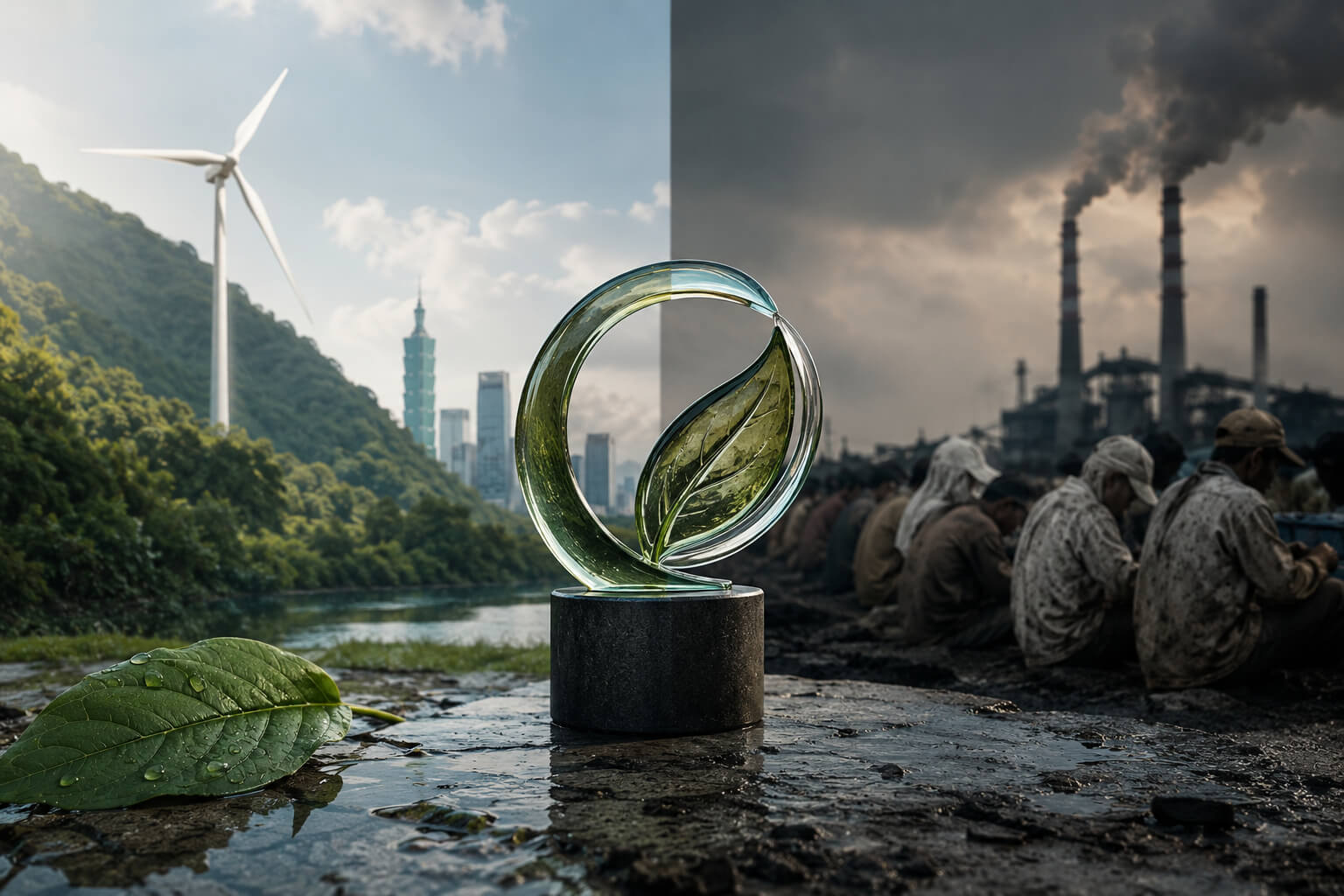
The sustainability awards programmes run in Taiwan are now under fire after an activist report revealed that a number of winning companies were accused of environmental violation, labour breaches, lack of occupational safety, and poor climate change performance.
In its report published earlier this month, the Taiwan Climate Action Network Research Centre and Green Citizens’ Action Alliance said that nearly half of 113 manufacturing companies honoured by sustainability awards in 2025 were reported to have committed violations of labour and environmental laws. It argues that Taiwan’s ESG award systems do not impose stringent standards in assessing legal compliance, occupational safety, pollution, and climate actions among winning companies.
Taiwan’s ESG Awards Are Questioned Over Greenwashing
The findings fuel worries that ESG awards are rewarding companies whose performance on climate and sustainability matters may fall below expectations. Civil societies claim that award winners should be screened for their performance in these areas. Otherwise, ESG awards will become a component of Taiwan’s broader greenwashing problem.
For its study, the researchers reviewed the environmental impact, labour and occupational safety conditions, and climate performance of awarded companies. They focused on the most environmentally harmful industries, including manufacturing, petrochemical, steel, cement, and semiconductors industries.
TCSA Winners Included Firms That Breached Labour and Environmental Laws
The report singles out the Taiwan Corporate Sustainability Awards (TCSA). Of 93 manufacturing companies awarded by the programme, 20 percent had environmental violations. Nearly 40 percent had violated labour laws and had cases of deaths in the workplace.
The report gives a list of such companies. For example, Taiwan-based Unimicron Technology, which supplies AI server substrate materials, has repeatedly won TCSA sustainability performance awards since 2014. However, the company has also frequently breached Taiwan’s Water Pollution Control Act. In May 2024, excessive copper discharge from one of its plants led to a fine of NT$3.1 million because discharge levels surpassed the permissible norms by seven times.
The study also drew attention to the Taiwan state-owned oil and gas company CPC Corp. The researchers said that CPC was behind 89 violations of Taiwan’s Air Pollution Control Act. The firm acknowledged just 18 serious penalties. Besides, it had 60 fire and workplace safety accidents, 35 of which resulted in deaths.
Award-Winning Companies Fail on Climate Performance
Besides the labour and environmental issues, the report also reveals that several winning companies have failed to meet Taiwan’s climate targets.
Of 38 major-emitting winners of 2025 TCSA, six have yet to make net-zero targets by 2050. Another 11 failed to meet Taiwan’s emission reduction targets by 27% (minus 2% or plus 2%) by 2030.
Renewable energy sources are another problem for some winning companies. The research indicates that 28 companies did not meet Taiwan’s target of generating at least 30% electricity using renewables by 2030. Another 28 did not disclose information on compliance with their renewable energy obligations as large power users.
Companies Using Coal-Fired Power Still Win Sustainability Awards
Use of fossil fuels is a key problem for Taiwan’s industry, and the report shows that some companies using coal-fired power plants won TCSA in 2025. Nine companies still using coal-fired power generation are among the award-winning firms. Of these, eight have yet to set a timeline for ending coal use. Moreover, five increased coal usage over the past year.
As we can see, ESG award programmes do not take into account companies’ actual efforts in decarbonisation. Use of fossil energy sources increases carbon emissions and leads to air pollution.
Semiconductor Industry Needs To Increase Renewable Energy Use
One of Taiwan’s key economic sectors, semiconductor manufacturing, was also mentioned in the report because it has an enormous electricity consumption.
In its statement, Green Citizens’ Action Alliance explains that the semiconductor industry makes up a considerable part of Taiwan’s electricity consumption and manufacturing emissions. The group warns that failing to address low energy efficiency and increasing renewable energy use might harm Taiwan’s competitiveness because of pressure from international technology companies that demand a renewable electricity source for manufacturing of components.
As the researchers explain, major global players, including Apple, Microsoft, and Nvidia, committed themselves to achieve a goal of using 100 percent renewable energy by 2030. Therefore, the suppliers, including companies operating in Taiwan, need to increase their use of renewable energy.
Civil Society Groups Call for Changes in Sustainability Award Criteria
The researchers recommended introducing the practice of excluding companies that had major pollution cases or serious workplace accidents from winning awards. Also, they suggested considering legal compliance, climate transition strategies, plans for ending coal use, and national climate objectives when selecting award winners. It will ensure that the award-winning firms are truly making a difference in decarbonisation efforts.
This issue becomes even more important amid upcoming implementation of the IFRS S2 climate disclosure requirements in the next two years.
Why This Matters
As the report demonstrates, there is a big problem with the current practices of sustainability awards. Such awards cannot inspire trust because they might reward companies for poor performance on climate and labour. Therefore, Taiwan’s awards need more strict criteria and disclosure rules to help award-winning companies perform better.