
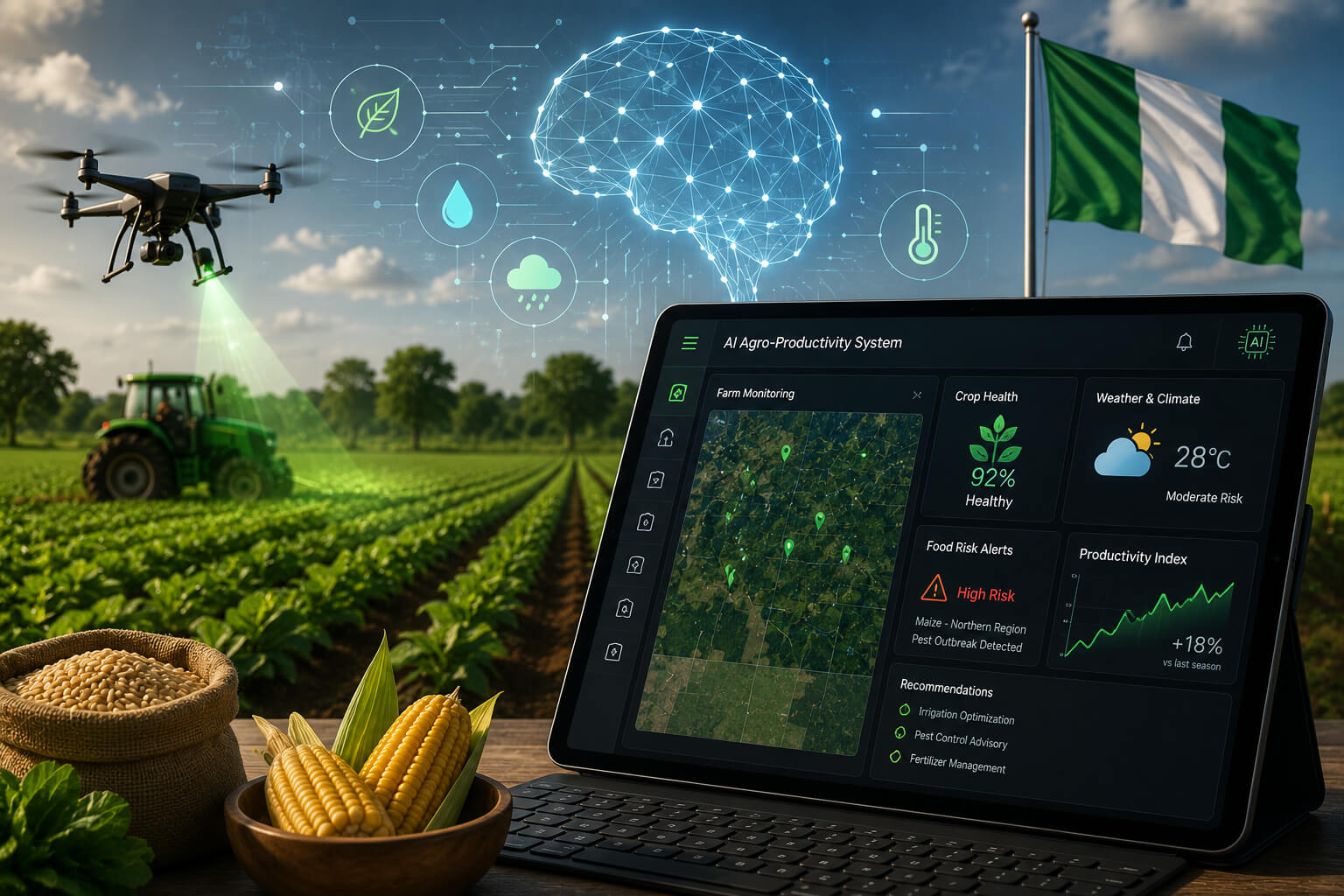
Nigeria is bringing artificial intelligence into the farm field. Not as a shiny experiment. Not as another digital agriculture slogan. This one is meant to watch crops from above, follow production in real time, and give the government better answers before food problems get worse.
The country has launched the National Agro-Productivity System, or NAPS, an AI and satellite-powered platform designed to monitor farmland, crop growth, yield expectations, and production risks.
It is a big move for Nigeria’s food security plans. Also a very practical one. When climate shocks, inflation, and food supply pressures keep hitting the same system, guessing is no longer enough.
Nigeria AI Agro-Productivity System Starts With Satellites and Data
The National Agro-Productivity System was launched through a partnership involving the Federal Government of Nigeria, OCP Africa, and geospatial intelligence firm Ground Truth Analytics.
The agreement was formalized on July 17 during an official Nigerian government visit to Morocco. A Memorandum of Understanding was signed by the partners, setting up one of the more ambitious AI-backed agricultural monitoring projects on the continent.
At the center of the system is a simple but powerful idea: Nigeria needs faster, clearer agricultural data.
The platform will use high-resolution satellite imagery and AI algorithms to identify cultivated farmland, recognize crop types, monitor crop development, and estimate potential yields. Satellite imagery will reportedly update every five days, giving authorities a much better view of what is happening during the growing season.
That matters because many agricultural decisions are still made too late. After planting. After harvest. After prices have already moved. After food pressure has already reached households.
Why Nigeria Wants Better Crop Monitoring Now
Agriculture is not a side issue for Nigeria. It is one of the country’s most important economic sectors, contributing around 24% of GDP and employing more than one-third of the workforce, according to World Bank figures cited by African Sustainability Matters.
Millions of smallholder farmers depend on the sector. So do food markets, rural communities, government planning, and inflation forecasts.
But the risks are piling up. Climate variability. Land degradation. Insecurity. Unstable food prices. Delayed crop data. Fragmented reporting.
That combination makes planning difficult. It also makes mistakes expensive.
With NAPS, the government wants to know earlier where crops are growing, how they are developing, which areas may fall short, and where intervention may be needed before the situation turns into a food security problem.
Not perfect control. Better warning. That alone can change decisions.
NAPS Could Help With Food Imports, Exports and Grain Reserves
The system is expected to support decisions on food imports, exports, strategic grain reserves, and emergency interventions during periods of climate stress.
That is where the platform becomes more than a farming tool.
If Nigeria can estimate production risks earlier, officials can act before shortages hit harder. They can adjust food reserve planning, prepare market responses, support vulnerable areas, or review import needs with stronger evidence.
This is the kind of data governments often wish they had before a crisis. Not after.
The Food and Agriculture Organization has long emphasized the value of timely agricultural data for anticipating shortages and improving market stability. Nigeria is now trying to build that capability into a national system.
Climate-Smart Agriculture Needs Faster Information
Climate-smart agriculture sounds like a neat policy phrase. On the ground, it is messier.
Rainfall shifts. Heat rises. Floods arrive at the wrong time. Droughts stretch longer than expected. Farmers make decisions under pressure, often with limited information.
NAPS is designed to help close part of that information gap.
By monitoring crop conditions during the season, the platform could help authorities identify stress signals earlier. That may include weak crop growth, delayed planting, lower-than-expected cultivated areas, or regions facing production risk.
This does not solve climate change. Obviously.
But it gives policymakers and agricultural planners a better dashboard for responding to it. In a warming climate, that kind of visibility becomes increasingly valuable.
Nigeria Plans a Phased Rollout
Nigeria will not roll out NAPS across the entire country at once.
Authorities plan to start with a pilot program in one state. After that, the system will expand to three additional states, before eventually reaching 15 priority agricultural states.
That phased approach makes sense. A national agricultural data system is not just a technology install. It needs coordination with state governments, data teams, farmers, agencies, and decision-makers who must actually use the information.
The government has also said the data generated by the platform will be hosted on domestic servers.
That detail is important. Food production data is strategic. It touches national planning, economic forecasting, security, and trade. Keeping that data under domestic control fits into a wider conversation about digital sovereignty in Africa.
Nigeria Builds on Earlier Space-Based Agriculture Projects
NAPS is not Nigeria’s first step into satellite-backed agriculture.
The country has already used space-based technologies through the National Space Research and Development Agency. In 2024, Nigeria introduced CropWatch, a satellite-based crop monitoring platform meant to improve agricultural forecasting and land-use monitoring.
In 2025, the country also worked with the European Space Agency on the Innovative Agriculture Project, which used satellite imagery to support soil analysis, crop suitability guidance, and planting schedule recommendations.
Those projects focused more directly on farm-level support.
NAPS goes wider. It is built for national planning, production intelligence, and food security decisions at government level.
That shift is worth watching.
AI Is Moving Into Africa’s Food Systems
Across Africa, governments are paying more attention to digital agriculture, remote sensing, climate information systems, and precision farming.
Kenya, Rwanda, Ghana, South Africa, and other countries have all explored digital tools to improve productivity and climate resilience. Nigeria’s NAPS adds another layer to that trend by combining AI, satellite imagery, and national agricultural governance.
It also shows how sustainability work is changing.
This is not only about planting more crops or distributing more fertilizer. It is about knowing what is happening across farmland in near real time. It is about making food systems less blind.
That may sound less dramatic than a new dam, a new seed variety, or a major subsidy package. Still, better data can quietly decide whether a policy works or fails.
The Real Test Comes After the Launch
The technology sounds strong. But the success of NAPS will depend on what happens next.
Will the data be accurate enough? Will state governments use it? Will agencies coordinate? Will farmers eventually benefit from the insights? Will the system survive beyond the launch announcement?
Those questions matter.
AI and satellite systems can produce impressive dashboards. Food security, though, improves only when those insights lead to faster decisions, better support, and smarter planning.
Nigeria has taken an important step. Now comes the harder part: turning agricultural intelligence into real protection for farmers, consumers, and food markets.
If it works, NAPS could become more than a national platform. It could become a model for climate-smart agriculture across Africa.
Sources
- African Sustainability Matters – Nigeria launches AI-powered national agro-productivity system to strengthen food security and climate-smart agriculture
- Food and Agriculture Organization of the United Nations
- World Bank – Nigeria Overview
- African Union – Digital Transformation Strategy for Africa 2020–2030