

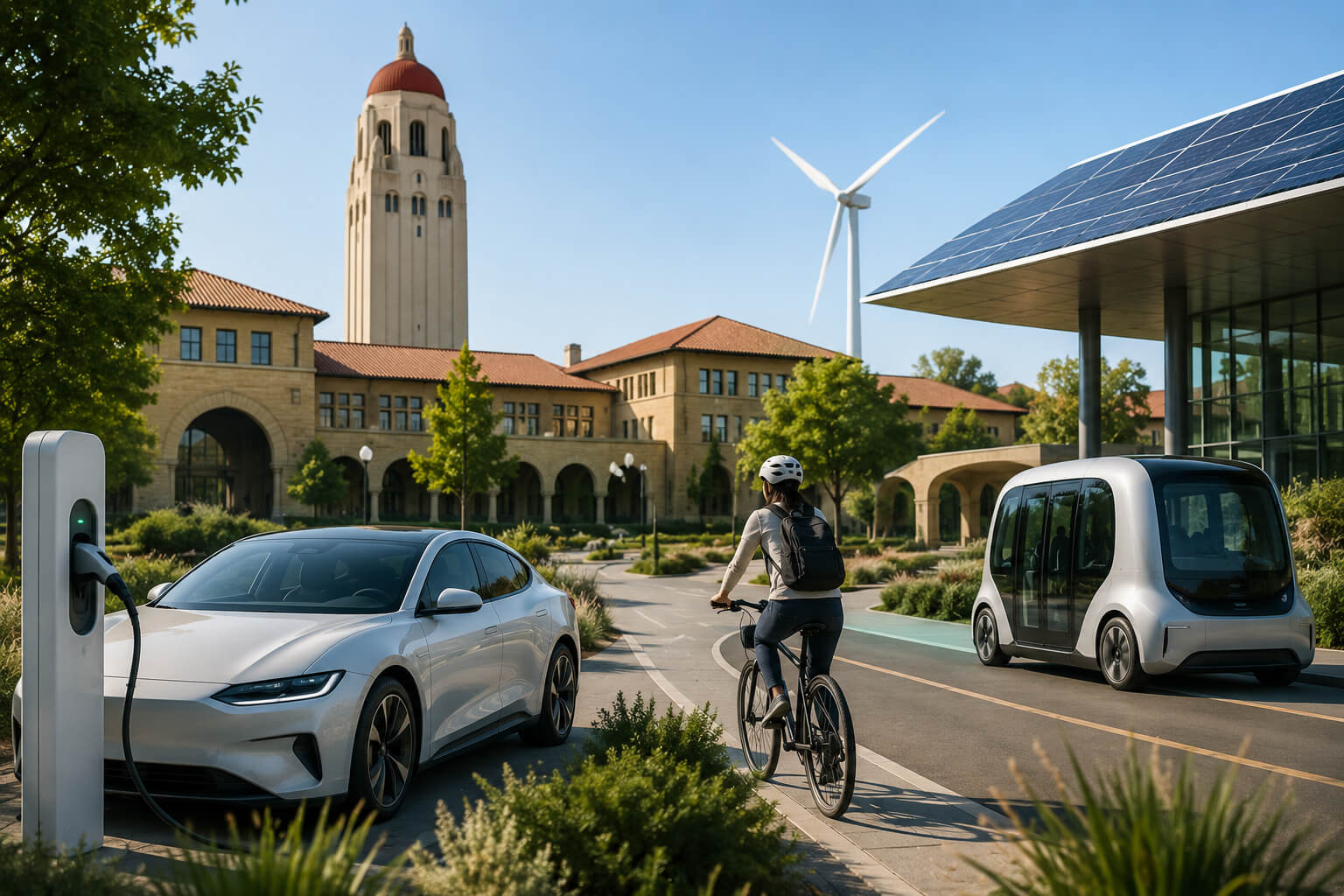
Stanford University has introduced the newly created Stanford Sustainable Mobility Center, which will seek to drive the future of sustainable transport solutions through its multidisciplinary work on cleaner and more efficient mobility systems.
The new center is a joint venture between Stanford’s Precourt Institute for Energy and other university departments aimed at tackling one of the globe’s most pressing climate issues: mobility sector emissions. Per Stanford’s Sustainable Mobility Center, transportation contributes up to 28% of greenhouse gases emitted in the US and 15% worldwide.
A Novel Research Institute to Advance Sustainable Transport
At its core, Stanford’s Sustainable Mobility Center seeks to address issues associated with increasing people and goods’ mobility without worsening environmental pollution. In line with its stated goals, it is guided by the principles of sustainability, equity, safety, and resilience.
Importantly, Stanford does not view sustainable transportation merely as a technological issue, but sees it as a complex topic that requires not only energy-efficient and eco-friendly vehicles, but redesigned mobility systems and urban infrastructure.
Focus Areas for Research Activities
The research activities undertaken by the Stanford Sustainable Mobility Center will address five critical dimensions of sustainable mobility, including:
- Sustainable energy systems
- Sustainable infrastructure
- Safety
- Economic viability
- Sustainable design
The importance of considering all of these factors in unison in addressing the issue of sustainable mobility was highlighted in the announcement.
Reasons Behind the Focus on Sustainable Mobility
Despite being one of the toughest, transportation sector remains a prime area for achieving carbon neutrality, since it is deeply integrated into virtually every facet of contemporary societies.
Stanford’s Sustainable Mobility Center will seek to facilitate progress in this area by combining university’s research efforts with industrial, governmental, and community initiatives to achieve better energy efficiency, increased accessibility, economic development, and improved quality of life.
Shaping Sustainable and Equitable Mobility Systems
An integral part of the research program at Stanford’s Sustainable Mobility Center is the focus on designing mobility systems that are safe and accessible, rather than just efficient in terms of resource consumption.
Today, sustainable mobility goes hand in hand with public health, city design, economic growth, and climate adaptation.
How This Initiative Might Impact the Future of Transport Sector
Stanford’s latest effort to advance climate research underscores the increasingly important role of academia in solving climate-related issues.
With governments around the world looking for solutions to mitigate emissions of cars, trucks, airplanes, and transport infrastructures, research institutes like Stanford’s new center might become indispensable instruments in