
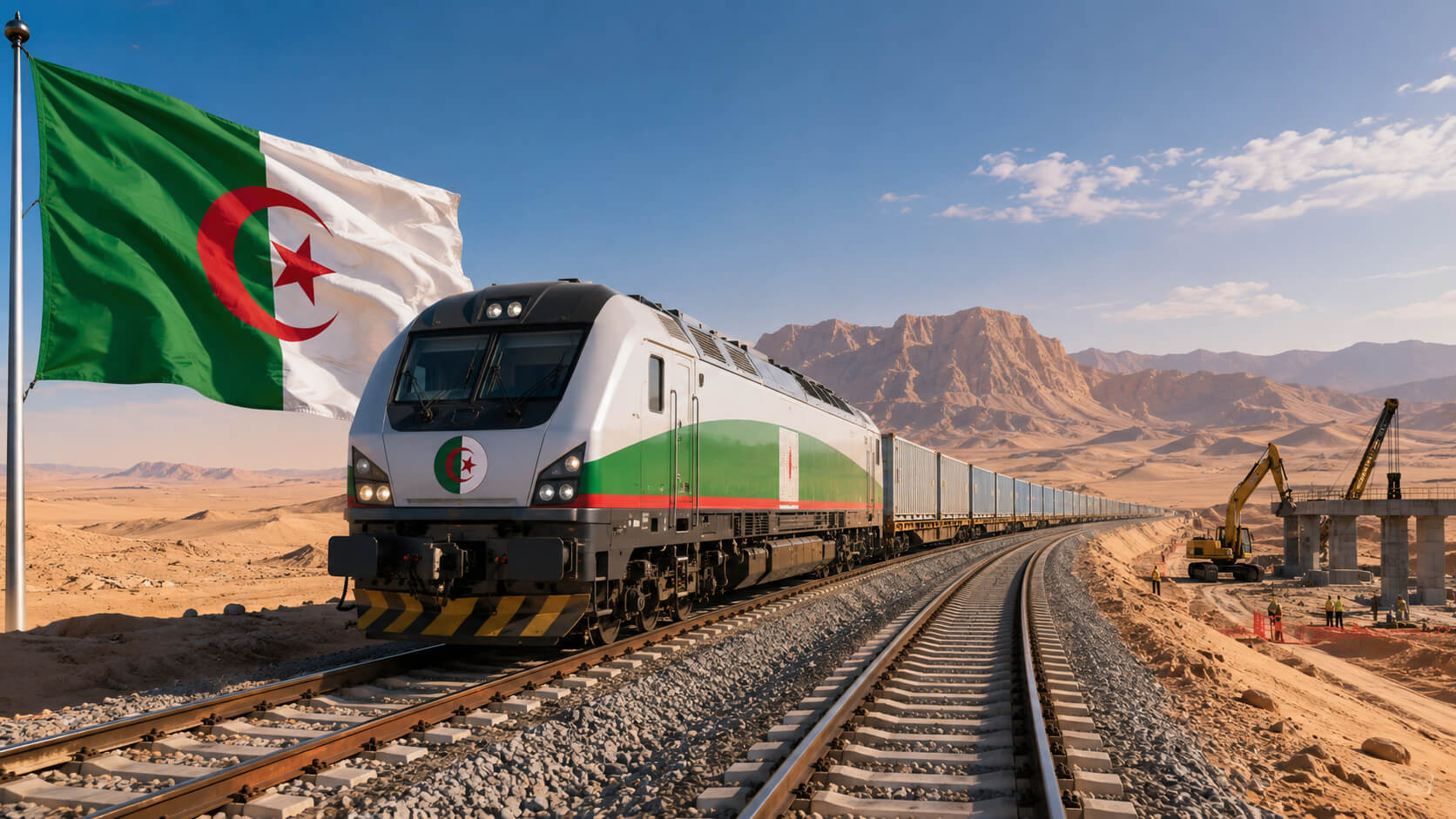
Moving freight across the Sahara is slow, expensive and heavily dependent on roads. Algeria wants to change that with steel tracks.
The African Development Bank Group has approved $878.09 million in financing for the second phase of the Laghouat–Ghardaïa–El Meniaa railway project, a major infrastructure programme that will push Algeria’s rail network farther into its southern regions.
The funding was announced on July 14, 2026, and will support construction of the 230-kilometre section between Ghardaïa and El Meniaa. That stretch forms part of a wider 495-kilometre corridor connecting Laghouat, Ghardaïa and El Meniaa.
It is a large transport investment. It is also part of something much bigger.
Algeria sees the line as a building block for a future Trans-Saharan rail corridor capable of connecting its Mediterranean-facing economy with the Sahel and other African markets.
AfDB Funding Moves the Railway Into Its Second Phase
The latest financing covers the second phase of the Laghouat–Ghardaïa–El Meniaa railway programme.
The African Development Bank previously approved a €747.32 million loan for the first phase in December 2025. That earlier package supports development of the Laghouat–Ghardaïa section, while the new funding takes the railway another 230 kilometres south toward El Meniaa.
Together, the two phases cover the planned 495-kilometre route.
That distance matters. Southern Algeria contains agricultural areas, industrial opportunities and significant mineral resources, but long travel distances and limited transport infrastructure make those assets harder to develop commercially.
A railway does not solve every problem. It can, however, change the basic economics of moving people, machinery and heavy cargo across the country.
Algeria Wants Rail to Carry More of Its Economic Growth
Algeria’s economy has long depended on oil and gas. Diversification has been discussed for years, but new industries still need roads, ports, electricity and reliable logistics before they can grow at scale.
The new railway is meant to support that physical foundation.
Once operational, the corridor is expected to improve passenger and freight movement between northern and southern Algeria. Agricultural products, manufactured goods, construction materials and mining output could reach processing centres and national markets more efficiently.
Businesses based away from Algeria’s coastal economic centres may also gain better access to suppliers and customers.
It sounds obvious: connect places, reduce travel friction, encourage investment. In practice, that kind of infrastructure can take years to build and even longer to produce measurable economic results.
Still, without the connection, much of that development may not happen at all.
The Sustainability Case Is Mostly About Moving Freight Differently
Calling a railway sustainable does not automatically make it so.
Construction requires steel, cement, heavy machinery and substantial land work. Building tracks across desert terrain also brings engineering and environmental challenges, from extreme heat to sand movement and pressure on local ecosystems.
The longer-term argument rests mainly on what the railway could replace.
Rail systems can move large volumes of freight more efficiently than fleets of trucks, particularly across long distances. Shifting part of Algeria’s cargo traffic from roads to trains could reduce fuel use per tonne transported, ease congestion on major routes and limit damage caused by heavy vehicles.
Fewer long-haul trucks would also reduce pressure on road-maintenance budgets.
The climate benefit will depend on how the railway is operated, including the trains used, the energy powering them and the amount of freight that actually moves from road to rail. Those details should not be treated as a footnote.
Infrastructure can be lower-carbon without being low-carbon from day one.
Southern Algeria Could Become Easier to Reach
The Laghouat–Ghardaïa–El Meniaa line is designed to open areas that remain poorly connected to Algeria’s main transport system.
For residents, the most immediate benefit could be simpler mobility between southern communities and larger economic centres. For businesses, it could mean lower logistics costs and more dependable access to markets.
Construction may also create demand for local labour, equipment, accommodation and supporting services. Once the railway begins operating, new opportunities could emerge around freight terminals, warehouses, maintenance facilities and processing zones.
Not every station becomes an economic boomtown. Infrastructure announcements often come with optimistic forecasts that take far longer to materialise than expected.
The railway’s real impact will depend on what Algeria builds around it, not just the tracks themselves.
A Future Link Between North Africa and the Sahel
The project is considered a strategic section of a proposed Trans-Saharan railway running from Algiers toward Tamanrasset and, over the longer term, potentially connecting with Niger and the wider Sahel.
That vision remains a long-term one. Cross-border railway networks require common technical standards, customs coordination, security arrangements, financing and political cooperation. None of that is simple.
Yet the commercial logic is clear.
A functioning corridor could create a new route between Mediterranean ports and landlocked African markets. Goods arriving in northern Algeria could move south by rail, while agricultural and mineral products from inland regions could gain another route toward export markets.
The line could also support the goals of the African Continental Free Trade Area, which aims to increase trade between African countries.
Tariffs are only part of the problem facing intra-African trade. Products still need a practical and affordable way to cross borders.
Mining and Agriculture Could Gain From the New Connection
Southern Algeria holds mineral resources that are often located far from ports, processing facilities and industrial centres.
Transporting heavy raw materials by road over hundreds of kilometres is expensive. Rail can make those projects more commercially viable, especially when large and regular cargo volumes are involved.
The same principle applies to agriculture.
Farmers and food producers need reliable routes for moving crops, livestock products, fertiliser, equipment and processed goods. Better rail access could reduce delays and help connect southern production areas with population centres farther north.
That does not guarantee cheaper food or immediate industrial growth. It does remove one stubborn obstacle: distance made worse by weak infrastructure.
Algeria Is Betting on Infrastructure Before Trade Arrives
The $878 million financing reflects a familiar infrastructure gamble.
Build the connection first, then hope investment, industry and trade follow.
Sometimes they do. Sometimes expensive transport projects struggle because freight demand was overstated or surrounding economic zones were never developed. Algeria will need to coordinate the railway with industrial policy, mining projects, agricultural investment and regional trade planning.
Maintenance will matter too. Desert railways operate under punishing conditions, and long-term reliability cannot be secured by construction spending alone.
The project nevertheless gives Algeria a tangible way to link its diversification plans with regional integration.
Not a slogan. A physical corridor.
What the Algeria Trans-Saharan Railway Expansion Could Mean
The second phase of the railway is not yet the full Trans-Saharan network imagined by policymakers. It is one section inside a much more ambitious plan.
But major corridors are rarely built all at once.
The Ghardaïa–El Meniaa section pushes Algeria’s railway system farther south, strengthens the link between remote regions and national markets, and creates a possible foundation for future trade routes into the Sahel.
Its sustainability value will ultimately be judged by results: how much cargo moves away from roads, whether surrounding communities benefit, how construction impacts are managed and whether the line remains reliable after the launch ceremonies are over.
For now, Algeria has secured another large piece of the financing.
The harder part is turning those kilometres of track into lasting economic and environmental value.
Sources
African Development Bank Group – Algeria: African Development Bank Approves US$878 Million for the Second Phase of the Laghouat–Ghardaïa–El Meniaa Railway Line
African Development Bank Group – €747 Million Loan for the First Phase of the Railway Project
African Development Bank MapAfrica – Laghouat–Ghardaïa–El Meniaa Railway Project
African Sustainability Matters – African Development Bank Approves $878 Million for Algeria’s Trans-Saharan Railway Expansion