
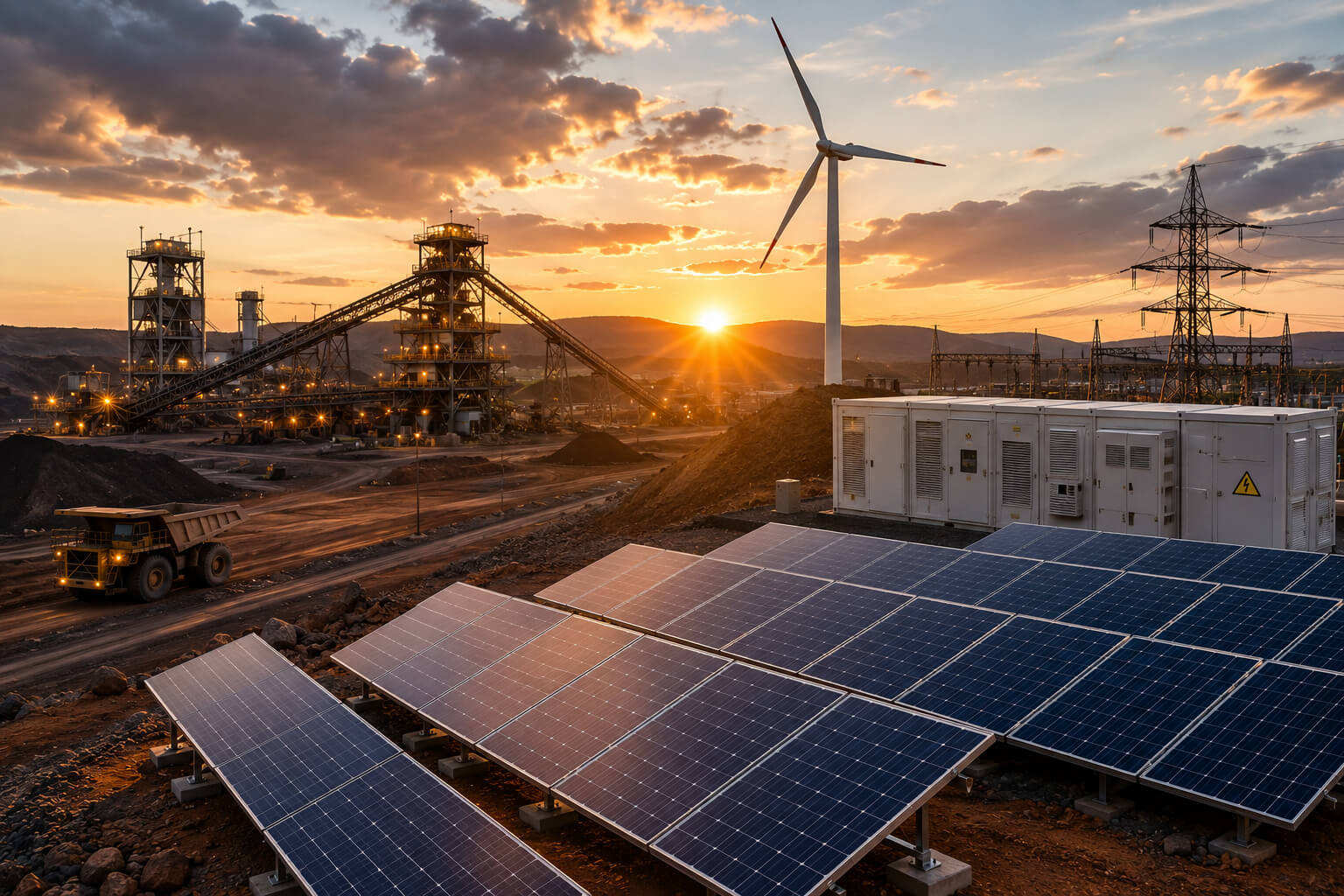
South Africa’s mining industry has relied heavily on the national grid for decades, but that model is changing. Major mining companies are investing more aggressively in renewable power as they try to secure reliable electricity, lower operating costs and reduce emissions.
Anglo American, Sibanye-Stillwater and Exxaro are among the companies expanding their use of wind and solar power across South African operations. Renewable energy is no longer being treated only as a sustainability initiative. For many miners, it is becoming a practical business decision.
South African Mining Renewable Energy Is Becoming a Business Strategy
Mining requires enormous amounts of electricity. Underground operations depend on continuous power for ventilation, pumping, processing and material movement. Even short disruptions can affect productivity and increase costs. That pressure is pushing mining companies to look beyond traditional grid electricity and find more stable sources of energy.
Renewable power gives mining companies a way to diversify their supply while potentially locking in more predictable long-term electricity costs. South Africa’s electricity system still relies heavily on coal, but miners are increasingly seeing wind and solar as tools that can improve both operational resilience and environmental performance.
Anglo American Is Building Renewable Power at Scale
Anglo American has taken one of the industry’s largest renewable steps through Envusa Energy, its joint venture with EDF power solutions. The Koruson 2 renewable energy cluster combines 240MW of solar capacity with 280MW of wind capacity, bringing total generation to 520MW.
The electricity generated by the project can support operations linked to Kumba Iron Ore, De Beers and Valterra Platinum. Envusa Energy also has broader ambitions, targeting between 3GW and 5GW of renewable capacity across Southern Africa by 2030. That scale suggests Anglo American sees renewable energy as part of its long-term operating model rather than a short-term carbon reduction project.
The Eskom Grid Still Has an Important Role
Mining companies are reducing their reliance on Eskom-generated electricity, but that does not mean the national grid is becoming irrelevant. Renewable electricity can be generated in areas with strong wind and solar resources and then transported through the national transmission system to mines and industrial facilities located elsewhere.
This process, known as wheeling, allows companies to buy renewable electricity without building generation facilities directly beside every mine. Projects such as Koruson 2 depend on this infrastructure. Its 400kV substation can accommodate up to 1.5GW of renewable generation, showing how the existing grid remains central to South Africa’s changing energy landscape.
Sibanye-Stillwater Is Betting on Power Purchase Agreements
Sibanye-Stillwater is taking a different approach by using long-term power purchase agreements rather than owning every renewable energy asset directly. In February 2026, the company announced another agreement with Etana Energy covering around 220MW of renewable electricity.
The 10-year arrangement will provide electricity from a mix of wind and solar projects to Sibanye’s South African operations. The financial argument is significant. Sibanye expects its renewable strategy to deliver long-term electricity savings of around 20% to 30% compared with current Eskom utility rates, making clean energy attractive from both a sustainability and cost perspective.
Exxaro Is Building Solar Power Beside a Coal Mine
One of the more striking examples of South Africa’s energy transition comes from Exxaro. The company remains a major coal producer, yet it is also building a substantial renewable energy portfolio through Cennergi.
In July 2026, Exxaro officially opened its 68MW Lephalale Solar Project next to the Grootegeluk coal mine in Limpopo. The R1.7 billion facility covers around 185 hectares and contains more than 129,000 bifacial solar panels. The plant is expected to generate approximately 176GWh of renewable electricity every year and could supply around 30% of Grootegeluk’s electricity needs.
Solar Could Save Grootegeluk More Than R100 Million a Year
The Lephalale project also shows why renewable energy is gaining momentum inside the mining sector. Exxaro expects the solar facility to generate annual electricity savings of more than R100 million while reducing the mine’s dependence on grid power during daylight hours.
Exxaro’s wider renewable plans are even larger. Through Cennergi, the company wants its renewable portfolio to approach 1,000MW by the end of 2027 and eventually reach 1,600MW by 2030. Exxaro has also said it wants all of its coal mines powered by green energy by the end of the decade, creating an unusual but telling example of how fossil fuel producers themselves are adapting to the energy transition.
Renewable Power Will Not Replace Eskom Overnight
Solar and wind still have limitations for mining operations that run around the clock. Solar generation drops away at night, while wind output varies depending on weather conditions. Battery storage can help, but large-scale storage remains expensive and adds another layer of infrastructure.
That means mining companies are unlikely to rely on renewable energy alone in the near term. The more realistic model involves a combination of grid electricity, private solar and wind generation, storage systems, power purchase agreements and wheeling arrangements. Rather than replacing one electricity system with another, miners are building a more diverse mix of power sources.
South Africa’s Grid Could Become the Bigger Challenge
Generating renewable electricity is only part of the problem. The electricity still needs to reach mines, factories and other large users. Many of South Africa’s strongest wind and solar resources are located far from the country’s biggest industrial centres.
As private renewable investment increases, transmission capacity could become one of the biggest constraints. Companies may be willing to build new solar and wind facilities, but those projects still need reliable grid connections. Without enough transmission infrastructure, renewable generation could expand faster than the country’s ability to move that electricity to where it is needed.
Mining Is Becoming a Testing Ground for South Africa’s Energy Transition
South African mining companies consume large and relatively predictable amounts of electricity, making them attractive customers for renewable energy developers. Their demand can help support the financing of large wind and solar projects while giving developers long-term revenue certainty.
This is changing the role of mining companies in the energy market. Miners were once mostly large electricity customers. Now they are becoming power buyers, infrastructure partners and renewable energy investors in their own right. That shift could influence how South Africa develops its wider electricity market over the next decade.
The Renewable Mining Model Could Spread Across Africa
South Africa is not the only African country where mining companies face unreliable grids, high electricity costs or limited generation capacity. Renewable energy could become increasingly attractive to mines across the continent, particularly in regions where solar resources are strong and grid access remains weak.
The model will not be easy to copy everywhere. Large renewable projects require significant capital, stable regulation, reliable transmission infrastructure and bankable long-term contracts. Bigger mining companies are better positioned to absorb those costs, meaning smaller operators may adopt renewable energy more slowly.
South African Miners Have Found Another Reason to Go Green
Climate targets helped bring renewable energy onto mining-company agendas, but economics may prove even more powerful. When solar and wind can lower electricity bills, improve energy security and reduce emissions at the same time, the business case becomes much harder to ignore.
For South African miners, renewable power is increasingly becoming part of core infrastructure rather than a separate environmental project. The biggest question now is whether the country’s grid, storage systems and electricity market can expand quickly enough to support the pace of investment.
Sources
- Africa Sustainability Matters — South African mining companies accelerate renewable power investment as energy security and decarbonisation converge
https://africasustainabilitymatters.com/south-african-mining-companies-accelerate-renewable-power-investment-as-energy-security-and-decarbonisation-converge/ - Anglo American Kumba Iron Ore — Kumba Iron Ore advances decarbonisation and energy resilience through Envusa Energy partnership
https://www.angloamericankumba.com/media/press-releases/2026/24-04-2026 - African Mining — Exxaro powers ahead with renewable energy strategy
https://www.africanmining.co.za/2026/07/16/exxaro-powers-ahead-with-renewable-energy-strategy/ - African Mining — Sibanye-Stillwater secures an additional 220MW power purchase agreement
https://www.africanmining.co.za/2026/02/17/sibanye-stillwater-secures-an-additional-220mw-power-purchase-agreement/