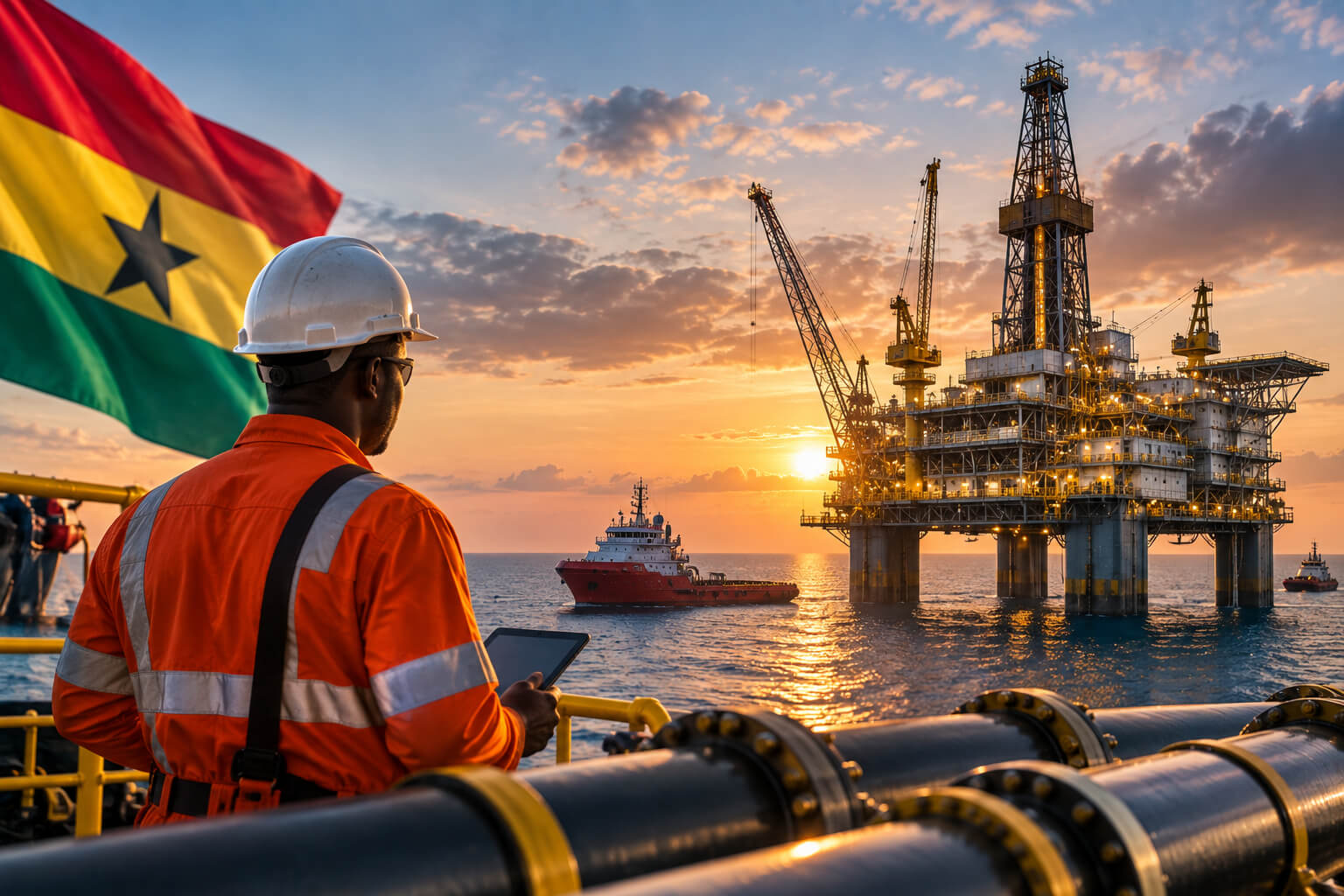
Ghana is reworking the economics of offshore oil exploration as it tries to bring major international energy companies back into its deepwater sector. The government has proposed cutting the Ghana National Petroleum Corporation’s initial carried interest in new upstream projects from 15% to 10%, a move that could make projects more attractive to investors such as Shell and Chevron.
The proposal comes as Ghana looks for ways to revive investment in its petroleum industry. Oil production has fallen from earlier peaks, while expensive deepwater exploration continues to demand large amounts of capital. Rather than holding onto a bigger share of projects that may never move forward, the government appears increasingly willing to accept a smaller state stake if that leads to new drilling and production.
Shell and Chevron Move Closer to Ghana’s Deepwater Sector
Ghana’s government, the Ghana National Petroleum Corporation and its exploration subsidiary have signed a non-binding memorandum of understanding with Shell Overseas Holdings and Chevron Sub-Saharan Africa Ventures. The agreement covers potential exploration and production activities within the South Deepwater Tano Cape Three Points block and gives both companies a framework for further negotiations.
The deal is still at an early stage. Shell and Chevron have not committed to immediate drilling, and the parties still need to agree on licence terms, investment obligations and regulatory approvals. Even so, the involvement of two major international energy companies signals renewed interest in Ghana’s offshore potential. For Accra, attracting companies with the financial capacity and technical experience to handle complex deepwater projects could be an important step toward restoring momentum in the sector.
Ghana Wants to Cut GNPC’s Carried Interest to 10%
One of the biggest changes being discussed is the reduction of GNPC’s initial carried interest from 15% to 10%. Under Ghana’s current petroleum framework, the state oil company is entitled to a minimum participating interest in upstream projects. Private contractors effectively finance the exploration and development costs attached to that share until production begins.
Reducing the percentage would leave international investors with a larger economic interest in successful projects. Ghana hopes that this could improve potential returns and make expensive offshore exploration easier to justify. The trade-off is clear. The state would directly control a smaller percentage of future projects, but it could benefit from increased investment, taxes, employment and petroleum revenue if more developments actually reach production.
Falling Oil Production Is Adding Pressure
Ghana has another reason to reconsider its petroleum investment terms. Oil output has declined significantly from earlier highs. Crude production reached roughly 71.4 million barrels in 2019, but annual output had fallen to around 37.3 million barrels by 2025, according to figures cited by Ghana’s Public Interest and Accountability Committee.
Lower production also affects government revenue. Petroleum receipts weaken when fewer barrels are produced, particularly when mature fields begin to decline and new discoveries fail to replace lost output. Ghana therefore faces a difficult calculation. Maintaining tougher commercial terms may protect the government’s percentage share, but those terms matter less if investors decide that new exploration is not commercially attractive enough to pursue.
South Deepwater Tano Is a Difficult Oil Prospect
The South Deepwater Tano acreage is not a simple project. AGM Petroleum previously operated the block and drilled ultra-deepwater wells, including the Nyankom discovery, before relinquishing the acreage in 2023. Further development would likely require substantial capital, additional exploration and careful assessment of whether discovered resources can be developed economically.
This background helps explain why Ghana is reconsidering its fiscal approach. Deepwater drilling carries high upfront costs, long development timelines and considerable geological risk. Even major companies such as Shell and Chevron will only move ahead if the potential returns justify those risks. Ghana is therefore trying to create terms that are competitive enough to bring international capital back into areas that have already proved technically challenging.
Ghana Is Considering Wider Petroleum Reforms
The proposed reduction in GNPC’s carried interest is only one part of a broader review. Ghana is also considering extending petroleum agreements from 25 years to 30 years. Other possible changes include allowing companies to carry tax losses forward for longer periods, changing the timing of signature bonus payments and introducing royalty structures that better reflect the technical difficulty of operating in deeper waters.
Taken together, these reforms would make Ghana’s upstream sector more attractive to investors. The government appears to be shifting its focus away from maximising its percentage share in individual projects and toward improving the overall chance that projects move forward. Supporters of this approach argue that a smaller percentage of an active and profitable field may ultimately generate more value than a larger percentage of a project that never reaches production.
The Sustainability Question Is More Complicated
Ghana’s push for renewed oil investment comes at a time when governments around the world are also dealing with energy transition pressures. The sustainability debate is therefore more complicated than simply asking whether the country should produce more oil. It also involves how petroleum revenues are managed, whether new projects create long-term domestic value and how continued fossil fuel development fits alongside future clean energy priorities.
New offshore investment could bring foreign exchange earnings, government revenue, jobs and business opportunities for local suppliers. At the same time, it would extend Ghana’s dependence on oil markets and could increase the challenge of balancing petroleum development with climate and energy transition goals. The long-term impact will depend heavily on how transparently contracts are managed and whether revenue from new production supports broader economic development.
Parliament Still Has a Major Role
The proposed reforms have not yet been fully secured. Ghana’s existing Petroleum Exploration and Production framework includes provisions governing state participation and the duration of petroleum agreements. Any major changes to these rules will need political and legislative backing before they can permanently reshape the investment environment.
The memorandum involving Shell and Chevron is also non-binding. The more important stage will come when the parties negotiate detailed exploration commitments, financial terms, drilling schedules and minimum work programmes. These details will determine whether the current interest develops into a serious upstream investment or remains at the preliminary discussion stage.
Ghana Is Choosing Investment Over a Bigger Percentage
Ghana’s strategy reflects a fairly practical calculation. A larger state share looks attractive when a project is active and profitable, but that percentage has limited value when companies are unwilling to invest. By offering a smaller carried interest, the government hopes to improve the economics enough to persuade companies to commit capital and begin exploration.
If Shell and Chevron eventually move forward with drilling, the South Deepwater Tano block could become an important test of Ghana’s new approach. Success could encourage more international energy companies to return to the country and potentially slow the decline in national oil output. Failure would raise harder questions about whether fiscal incentives alone are enough to restart investment in difficult offshore acreage.
For Ghana, the issue is no longer simply how much of an oil project the state should own. The bigger question is whether the country can create commercial terms attractive enough to bring new exploration back while still securing meaningful long-term value for the public.
Sources
African Sustainability Matters — “Ghana offers Shell and Chevron lower state stake in bid to revive deepwater oil investment”
https://africasustainabilitymatters.com/ghana-offers-shell-and-chevron-lower-state-stake-in-bid-to-revive-deepwater-oil-investment/
MarketScreener / Reuters — Coverage of Shell and Chevron’s preliminary agreement with Ghana
https://www.marketscreener.com/news/chevron-shell-sign-preliminary-agreement-with-ghana-as-country-reviews-oil-and-gas-sector-ce7858d3df8ffe27
Petroleum Commission Ghana — Investor engagement and Ghana’s upstream petroleum sector
https://petrocom.gov.gh/
MyJoyOnline — Coverage of Ghana’s South Deepwater Tano investment discussions
https://www.myjoyonline.com/