
POWERCHINA is building a much bigger renewable energy footprint in Egypt, and wind farms are only part of the story. The Chinese engineering and infrastructure group is advancing more than 1.8GW of wind power capacity across the country while also moving further into battery energy storage and local manufacturing.
The expansion gives POWERCHINA a broader role in Egypt’s clean energy transition. Its portfolio now combines operational wind generation, large projects still under construction and supporting infrastructure that could help Egypt manage more renewable power on its grid.
More Than 1.8GW of Wind Power Is Taking Shape
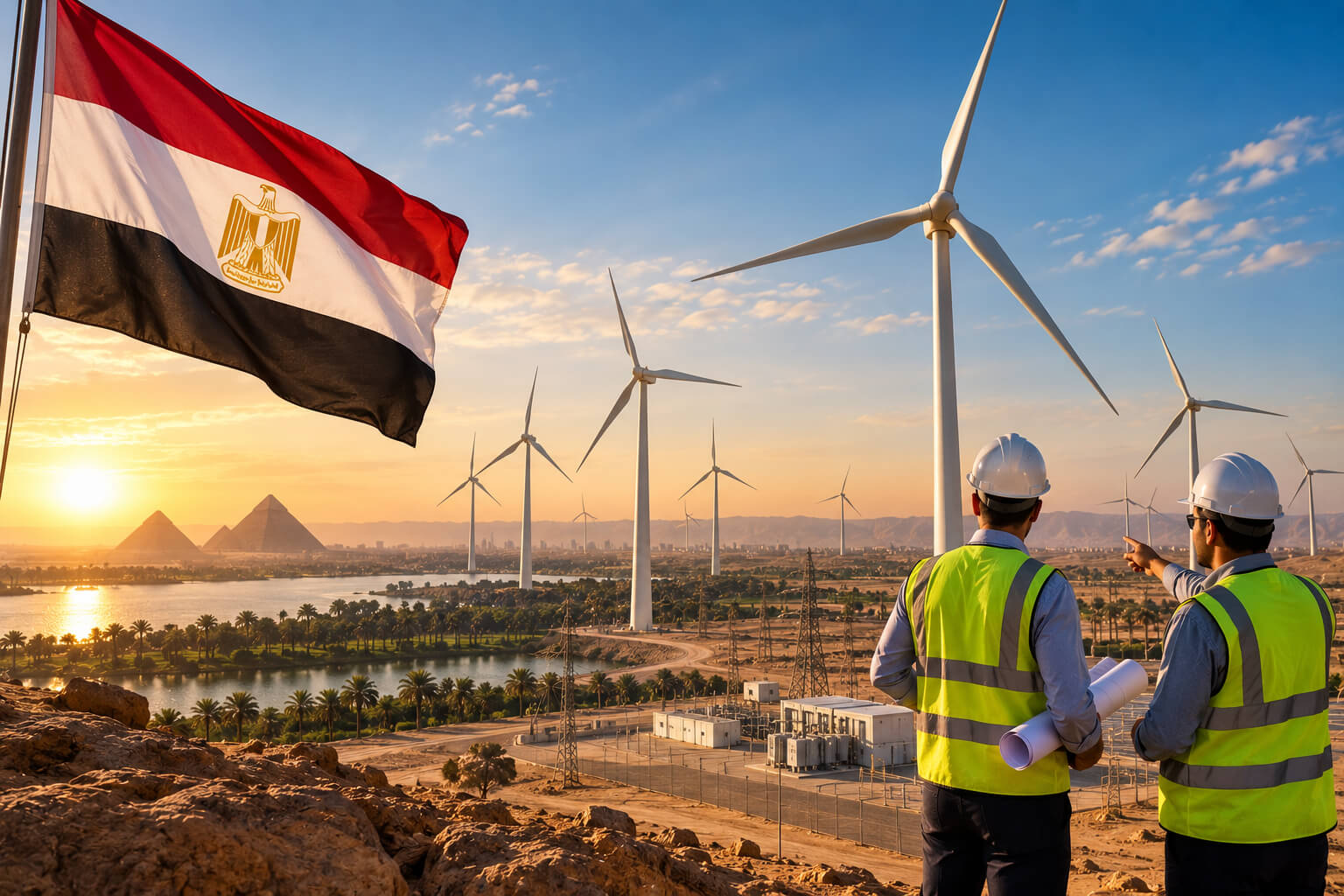
POWERCHINA’s current portfolio covers three major wind developments in Egypt. The 500MW Amunet Gulf of Suez Wind Project is already operating, while the 1.1GW Gulf of Suez Wind Project and the 202.5MW Ras Ghareb Wind Project remain under construction. Together, those projects take the company’s wind portfolio in Egypt beyond 1.8GW, giving it a significant position in one of North Africa’s fastest-growing renewable energy markets.
The 1.1GW Gulf of Suez project is particularly important because of its scale. POWERCHINA has described it as its first gigawatt-scale onshore wind project delivered under a full engineering, procurement and construction arrangement in the Middle East and North Africa. The development is expected to use 138 turbines, each with a capacity of 8MW.
Amunet Has Already Moved Into Commercial Operation
POWERCHINA already has a major operating reference point in Egypt. The 500MW Amunet wind farm began commercial operations in May 2025, giving the company experience that can be carried into its larger projects now under development.
The wind farm sits around 300 kilometres southeast of Cairo and approximately eight kilometres north of Ras Ghareb. It uses 77 turbines, while POWERCHINA handled engineering, procurement, construction and commissioning. The work also covered turbine foundations, internal roads, collection lines, meteorological towers and the project’s booster station.
Construction came with difficult conditions. Temperatures exceeded 40°C at times, while strong winds, sand erosion and challenging geological conditions added pressure to the schedule. Project teams adjusted concrete pouring times, strengthened temperature controls and closely monitored wind speeds during turbine installation. The project eventually secured its acceptance certificate ahead of the contractual deadline.
The 1.1GW Gulf of Suez Project Reaches Turbine Installation Stage
POWERCHINA’s much larger 1.1GW Gulf of Suez wind development has also moved into a more visible phase of construction. The first turbine was installed in December 2025, marking the start of turbine erection work across the project and bringing the development closer to future grid connection.
POWERCHINA signed the EPC contract with Suez Wind Energy in December 2024. The project is located near Ras Ghareb and Ras Shokeir in Egypt’s Red Sea Governorate. Once completed, the company expects the wind farm to generate more than 4.3 billion kilowatt-hours of electricity every year. That could be enough to supply more than one million households while cutting carbon dioxide emissions by around 2.2 million tonnes annually.
The project has also attracted major international financial support. In June 2026, the World Bank Group’s Multilateral Investment Guarantee Agency issued a $193.3 million guarantee covering ACWA Power’s equity investment in the development. Electricity from the wind farm will be sold to the Egyptian Electricity Transmission Company under a 25-year power purchase agreement.
POWERCHINA Is Expanding Beyond Wind Power
The company’s strategy in Egypt is becoming broader than simply building wind farms. POWERCHINA is also moving into energy storage and manufacturing, two areas that are becoming increasingly important as Egypt adds more renewable electricity to its energy system.
In August 2026, POWERCHINA began construction of a new energy storage manufacturing facility for Sungrow in Ain Sokhna. The facility covers around 50,000 square metres and is expected to become Sungrow’s first battery energy storage system manufacturing base in the Middle East and Africa.
The timing is important. Wind and solar power can produce large amounts of electricity, but generation changes depending on weather conditions. Battery storage can help manage those fluctuations by storing electricity when supply is high and releasing it when the grid needs more power. That makes storage increasingly valuable as Egypt expands renewable capacity.
Local Manufacturing Adds Another Layer to Egypt’s Energy Transition
The Ain Sokhna facility brings an industrial dimension to Egypt’s renewable energy expansion. Instead of relying entirely on imported clean energy equipment, local manufacturing could help the country build stronger supply chains around battery storage and related technologies.
POWERCHINA says the facility will support workforce development and local manufacturing while strengthening Egypt’s emerging clean energy supply chain. The impact could extend well beyond a single project. Building components locally can create technical jobs, attract suppliers and develop skills that remain in the country after construction ends.
That matters because the value of renewable energy projects is increasingly measured by more than installed megawatts. Governments are also looking at jobs, local procurement, technical expertise and manufacturing opportunities created around the projects.
Egyptian Contractors Are Taking a Bigger Role
POWERCHINA’s growth in Egypt has also created more opportunities for local companies. Elalamya General Contracting first worked with POWERCHINA as a civil works subcontractor on the 500MW Amunet wind project in 2023. That relationship later expanded into other wind developments in the Gulf of Suez and Ras Ghareb.
The company now works with dozens of Egyptian suppliers, subcontractors and consultants covering engineering, construction materials, labour supply, legal services and tax consultancy. POWERCHINA says it has created more than 2,000 direct jobs and over 10,000 indirect jobs in Egypt since entering the market in 2012.
Training has become part of that expansion as well. More than 350 professionals have reportedly received training in areas including quality control, occupational health and safety, logistics, social management and materials management. That gives local workers more exposure to large-scale renewable energy construction and project management.
The Gulf of Suez Is Becoming a Major Wind Power Hub
The Gulf of Suez is steadily emerging as one of Egypt’s most important renewable energy zones. Strong wind resources have made the area attractive to developers, and several large projects are now being built or planned around Ras Ghareb and nearby locations.
POWERCHINA is not the only company investing there. Other wind projects, including the planned NIAT and Rasgha developments, are also adding capacity to the region. Their presence reinforces the Gulf of Suez as a growing clean energy corridor where power generation, transmission infrastructure and storage could eventually develop together.
The concentration of projects also creates practical advantages. Developers can benefit from established roads, grid connections, local contractors and a growing pool of workers with experience in wind farm construction. Over time, that can make future projects easier and faster to deliver.
POWERCHINA’s Egypt Strategy Is Becoming More Ambitious
POWERCHINA’s activity in Egypt now stretches well beyond individual construction contracts. The company is involved in wind generation, battery storage, manufacturing, local supply chains and workforce training, giving its Egypt strategy a much wider footprint than it had just a few years ago.
More than 1.8GW of wind capacity remains the headline number, but the supporting infrastructure may become just as important. Egypt needs more renewable generation, but it also needs storage, manufacturing capacity, skilled workers and stronger local supply chains to support that growth.
POWERCHINA appears to be positioning itself across several of those areas at the same time. If the current projects move forward as planned, the company could become an increasingly important player in Egypt’s wider shift toward cleaner and more diversified energy.
Sources
Zawya reported on POWERCHINA’s expansion in Egypt and its portfolio of more than 1.8GW of wind power projects. The original article is available at https://www.zawya.com/en/zawya-green/powerchina-expands-egypt-footprint-with-1.8gw-wind-power-projects-477783
POWERCHINA provided additional details on its wind power and energy storage development in Egypt through a company announcement published by PR Newswire at https://www.prnewswire.com/news-releases/powerchina-advances-wind-power-and-energy-storage-development-to-support-egypts-sustainable-energy-transition-302869095.html
POWERCHINA also published project information on the 1.1GW Gulf of Suez wind development at https://en.powerchina.cn/2025-01/05/c_828851.htm and an update on the first turbine installation at https://en.powerchina.cn/2026-01/15/c_829045.htm
Further details on the 500MW Amunet wind project are available through POWERCHINA at https://en.powerchina.cn/2025-06/03/c_828955.htm
The World Bank Group’s Multilateral Investment Guarantee Agency published financing and project information for Suez Wind Energy at https://www.miga.org/project/suez-wind-energy-1