
The UAE is looking beyond simply producing more electricity. The bigger question now is how to build an energy system that can support fast economic growth without creating new pressure on reliability, affordability and sustainability.
Speaking at Middle East Energy 2026 in Dubai, Eng. Sharif Al Olama, Undersecretary for Energy and Petroleum Affairs at the UAE Ministry of Energy and Infrastructure, said the country is moving toward an energy system that is cleaner, smarter, more efficient and more resilient.
That shift comes as electricity demand rises across the country. Artificial intelligence, data centres, advanced manufacturing, transport electrification and new infrastructure projects are all adding pressure to the grid.
For the UAE, clean energy is no longer just a climate issue. It is becoming part of the wider economic story.
Economic Growth Is Reshaping the UAE’s Energy Needs
Energy supports almost every part of the UAE’s economic expansion. Factories need reliable electricity. Transport systems depend on it. Data centres cannot function without it, while AI infrastructure is introducing a new level of power demand that was far less significant only a few years ago.
Al Olama said energy should be seen as an economic enabler rather than just a utility service. Reliable and affordable power supports industrial growth, mobility, technology and investment. It can also influence competitiveness, particularly as countries compete to attract energy-intensive industries and large-scale digital infrastructure.
The UAE therefore faces a difficult balancing act. It has to increase available power while also making the overall system cleaner and more efficient. Expanding supply alone will not solve the problem.
The UAE Is Building a Broader Clean Energy Mix
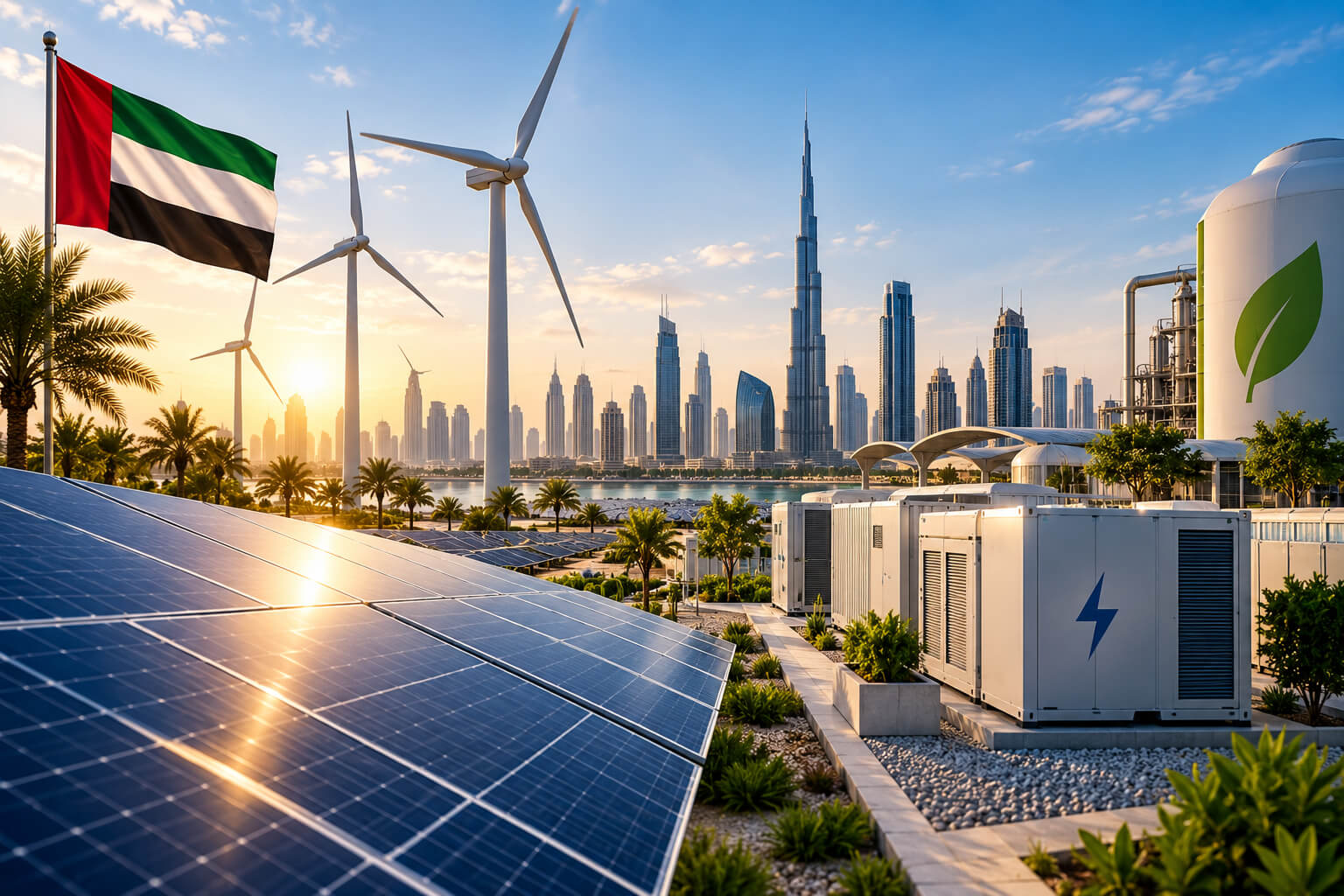
The country’s energy strategy does not rely on one technology. Solar power remains central, but nuclear energy, battery storage, smarter grids and new energy technologies are also becoming increasingly important.
The Barakah Nuclear Energy Plant already contributes a substantial amount of low-carbon electricity to the national grid. At the same time, the UAE continues to expand large-scale solar developments and invest in storage systems that can make renewable power more dependable.
One major example is the UAE’s planned renewable energy project combining 5.2 GW of solar generation with 19 GWh of battery storage. The idea is to produce renewable electricity on a much more consistent basis rather than relying entirely on sunlight conditions during the day.
That changes the role of renewables inside the grid. Solar power becomes more useful when energy can be stored and released during periods of higher demand.
AI Is Creating New Energy Pressure
Artificial intelligence has become an awkward part of the energy transition. It is helping industries become more efficient, but the infrastructure required to run AI systems can consume huge amounts of electricity.
Data centres are expanding quickly across the Gulf, driven by cloud services, sovereign AI initiatives and growing demand for advanced computing. That places additional pressure on utilities to provide stable power around the clock.
The UAE is already treating this as a strategic issue. If AI infrastructure continues to grow at its current pace, the energy system will have to evolve with it. More generation, better storage and smarter management will all be needed.
At the same time, AI itself could help utilities operate more efficiently. Predictive maintenance, automated monitoring and real-time demand forecasting can help power companies detect faults earlier and manage electricity supply more precisely.
Energy Efficiency Is Becoming an Economic Priority
Producing more electricity is one solution. Wasting less of it is another.
The UAE is placing greater emphasis on energy efficiency because lower consumption can reduce operating costs, ease pressure on electricity networks and delay the need for expensive new infrastructure.
Al Olama described efficiency as both an environmental and economic priority. Businesses that use energy more effectively can reduce costs, while governments can avoid some of the spending associated with constantly expanding generation and transmission capacity.
Dubai has already set ambitious targets through its Demand Side Management Strategy 2050. The plan aims to deliver efficiency savings of at least 30% by 2030 and 50% by 2050 compared with business-as-usual consumption across electricity, water and transport fuels.
Efficiency rarely attracts the same attention as a new solar farm or battery project, but it could end up playing an equally important role.
Turning Energy Ambitions Into Real Projects
Setting clean-energy targets is relatively easy. Converting those targets into commercially viable projects can be much harder.
The UAE-backed Global Energy Efficiency Alliance is trying to close that gap by bringing together governments, technology companies, industrial groups, utilities and financial institutions.
The goal is to identify practical energy-efficiency opportunities and connect them with financing, technology and technical expertise. That approach could help accelerate projects that might otherwise remain stuck at the planning stage.
During Middle East Energy 2026, companies including Siemens, Honeywell, Schneider Electric, First Abu Dhabi Bank, Hitachi Energy, Siemens Energy and Net0 signed agreements with the UAE Ministry of Energy and Infrastructure in support of the alliance’s wider efficiency agenda.
The technology already exists in many cases. The challenge is getting the right investment, policy support and commercial structure around it.
Smarter Electricity Grids Are Becoming More Important
Generating cleaner electricity is only part of the transition. That electricity also needs a grid capable of handling more complex supply and demand patterns.
UAE Energy and Infrastructure Minister Suhail bin Mohammed Al Mazrouei has highlighted the need for greater investment in electricity interconnections between countries and regions.
More connected grids can help balance supply, improve reliability and allow electricity to move between markets when demand changes. This could become particularly important as Gulf countries add more renewable energy, storage systems and large industrial loads.
The traditional electricity grid was designed around predictable power stations and relatively predictable demand. The next generation of infrastructure will have to deal with solar power, nuclear generation, batteries, AI-driven demand and increasingly digital control systems at the same time.
Energy Security and Sustainability Are Moving Together
The UAE is not presenting sustainability, reliability and affordability as separate goals. Its current approach is to move all three forward at the same time.
That is why the country continues to invest across a wide range of technologies rather than relying on one solution. Nuclear energy provides stable low-carbon power. Solar projects increase renewable capacity. Batteries improve flexibility. Energy-efficiency programmes reduce unnecessary consumption, while smarter grids help manage everything more effectively.
This is also closely tied to the country’s broader economic strategy. AI, manufacturing, transport, logistics and digital infrastructure all depend on a reliable energy system.
The transition is therefore becoming less about individual clean-energy projects and more about the design of the entire system.
Execution Will Be the Real Test
The UAE already has ambitious energy plans, major projects and significant investment behind them. The more difficult part now is execution.
Announcements alone will not determine whether the strategy succeeds. Progress will depend on how quickly new generation is built, how effectively grids are modernised, how much storage is deployed and whether efficiency improvements produce measurable results.
The pressure will only increase as electricity demand grows.
For the UAE, a cleaner energy system is no longer simply about reducing emissions. It is becoming a foundation for economic growth, industrial competitiveness and long-term energy security.
Sources
Zawya – UAE calls for cleaner, smarter energy system to support economic growth
https://www.zawya.com/en/business/zawya-green/uae-calls-for-cleaner-smarter-energy-system-to-support-economic-growth-476114
Emirates News Agency (WAM) – UAE adopts balanced approach to building cleaner, smarter, more efficient energy system
https://www.wam.ae/en/article/c227bkx-uae-adopts-balanced-approach-building-cleaner