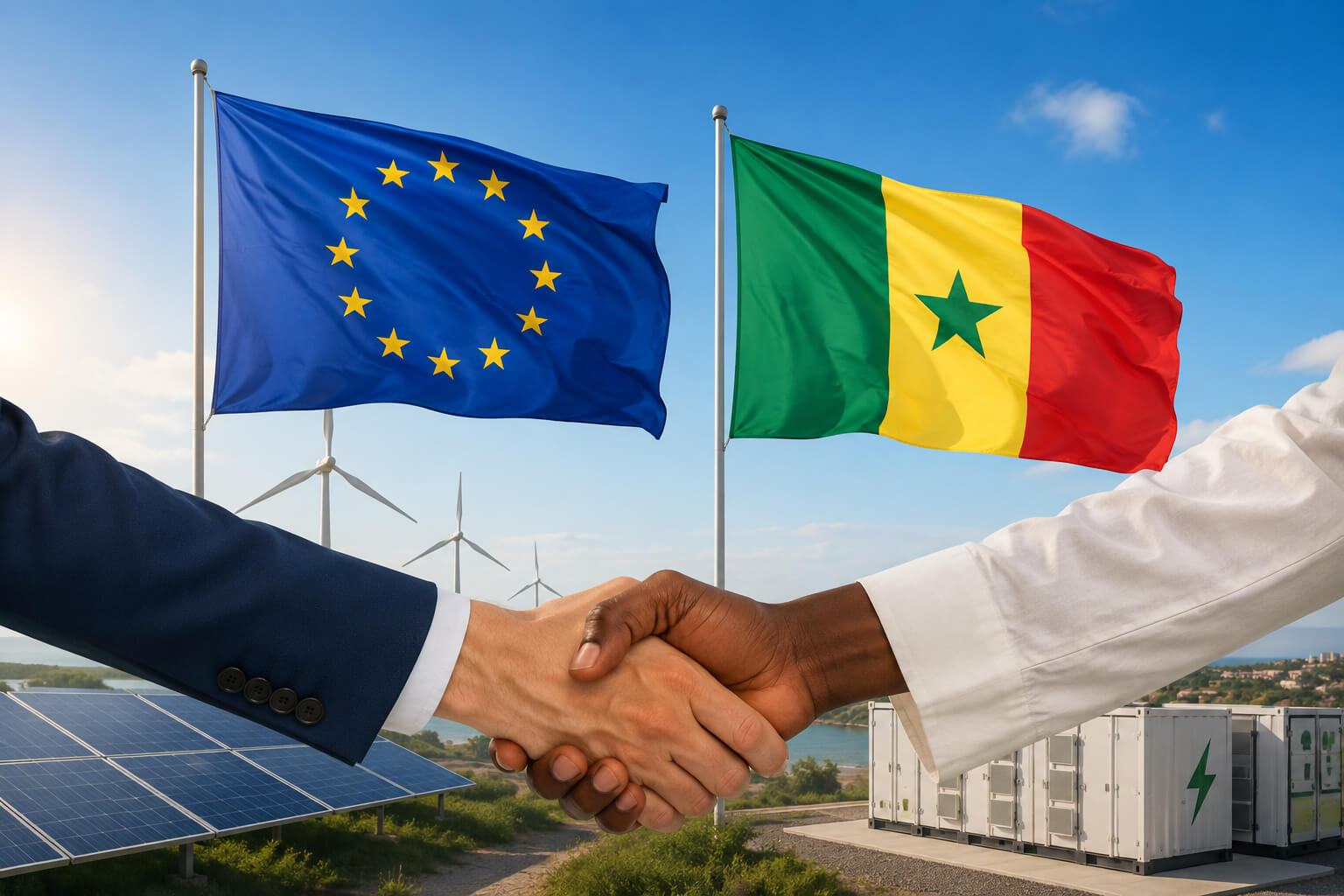
Solar panels alone don’t build a business. Someone still needs capital, a bit of training, and a reason to believe the lights will stay on long enough to justify the risk. That’s the gap the EU-Senegal clean energy partnership is now trying to close, and it’s a more interesting story than “EU funds more solar in Africa.”
Brussels has been backing Senegal’s power sector for years. What’s new is the pairing: renewable energy money now travels alongside entrepreneurship support, aimed squarely at rural areas where electricity has historically arrived without much else attached to it. Wire up a village, sure, but if nobody there can afford a freezer or a rice mill, the wires don’t do much for the local economy.
Two Senegalese Agencies Are Now Working the Same Problem Together
The mechanics of this come down to a partnership between two Senegalese institutions: DER/FJ, the General Delegation for Rapid Entrepreneurship for Women and Youth, and ASER, the Senegalese Rural Electrification Agency. One handles the grid. The other handles the money and mentorship entrepreneurs need to actually use it.
Under the arrangement, rural electrification gets bundled with financing, technical assistance, and business development services. An entrepreneur running a small aquaculture operation or agro-processing shop doesn’t just get a power line — they get help figuring out how to turn that connection into a functioning business. The two agencies are also sharing data to figure out which communities would benefit most from new electricity infrastructure, rather than building somewhat blindly and hoping demand shows up later.
Electricity Access Was Never Really the Whole Problem
For years, rural electrification programs across Africa have been graded almost entirely on connection numbers: how many households got hooked up, how fast, how cheap. That’s a reasonable enough metric, but it misses something. A farmer with a lightbulb and no irrigation pump hasn’t gained much economically. A shopkeeper who can now charge a phone still can’t refrigerate produce without more than a basic connection.
Development economists have been making this argument for a while now: electrification only pays off economically when it’s paired with productive use. Reliable power lets farmers cut post-harvest losses, expand irrigation, and run cold storage. It lets small manufacturers mechanize. It lets digital businesses exist at all. The DER/FJ-ASER partnership is essentially a bet that Senegal will get more out of every kilowatt if it treats electrification as an economic development tool rather than a utility rollout.
Where the Money and Training Are Actually Going
The programme has picked its priority sectors deliberately: agriculture, agro-processing, aquaculture, food preservation, cold storage, and digital services. None of that is random. These are the sectors where a stable power supply translates almost immediately into jobs and income — a cold room that stops fish from spoiling, a mill that processes grain locally instead of shipping it out raw, a digital platform that connects a rural producer to buyers in Dakar.
That’s the theory, anyway. Reliable electricity in these sectors tends to ripple outward: fewer wasted crops, more processing done closer to the farm, better market access through basic digital tools. Whether it plays out that cleanly in practice will depend on execution, but the sector selection itself reflects a fairly sharp read on where rural Senegal’s economic bottlenecks actually sit.
Women and Young Entrepreneurs Get Specific Attention
Rural Africa’s finance gap doesn’t hit everyone equally, and this programme leans into that reality instead of ignoring it. Women and young entrepreneurs face steeper barriers getting capital, building technical skills, and accessing the infrastructure that makes a business viable in the first place — this has been true for a long time and rarely gets fixed by electrification alone.
So beyond financing, beneficiaries in this programme get technical and managerial training meant to help their businesses actually survive past the startup phase. It’s a small but meaningful shift: instead of treating access to power as the finish line, the partnership treats it as one ingredient among several, with capital and skills-building filling in the rest.
This Fits Into Something Much Bigger Than Senegal
None of this is happening in isolation. It sits inside the EU’s Global Gateway strategy, the bloc’s push to mobilize infrastructure investment across partner countries, and it complements the Just Energy Transition Partnership already in place with Senegal. Under these frameworks, EU money isn’t just building solar and wind farms — it’s going into transmission lines, distribution networks, and governance reforms meant to modernize how Senegal’s power sector actually runs.
The goal, per EU officials involved, is an energy system that can support industrial growth and agricultural transformation while cutting the country’s reliance on fossil fuels. That’s a broader ambition than “add more renewables,” and it explains why entrepreneurship support shows up in what would otherwise be a straightforward energy story.
Senegal Already Has Real Renewable Energy Credentials
None of this is starting from zero. Senegal has spent the last several years building out utility-scale solar and wind projects and has become one of West Africa’s more credible renewable energy markets in the process. According to the International Renewable Energy Agency (IRENA), the country’s renewable capacity has grown steadily over the past decade, helped along by public-private partnerships and international development financing.
That track record matters here — it’s part of why the EU is comfortable layering entrepreneurship funding on top of the existing energy relationship rather than starting a new initiative from scratch.
The Rural-Urban Gap Hasn’t Closed, Though
Here’s the less flattering part of the picture. National electricity access in Senegal has improved a lot, but the gap between urban and rural areas hasn’t gone away. Limited infrastructure in rural communities still holds back agricultural productivity, business development, and access to basic services. The World Bank has flagged expanding electricity access as one of the country’s central priorities for reducing regional inequality and building more inclusive growth.
That’s the backdrop this partnership is working against. It’s not a victory lap — it’s an attempt to fix something that’s been stubbornly hard to solve through infrastructure spending alone.
What This Could Mean Beyond Senegal
Senegal’s approach is a useful data point for a broader argument playing out across the continent: that Africa’s energy transition works better when it’s designed as an economic development strategy, not just a construction project. As governments try to expand renewable power while also creating jobs for fast-growing populations, tying electricity access to entrepreneurship and local value creation looks like a more durable path than infrastructure investment on its own.
There’s also a climate angle worth naming. The Sahel is under increasing agricultural strain as weather patterns shift, so pairing renewable energy with climate-resilient economic activity isn’t just good development policy — it’s becoming a food security necessity too.
The EU’s continued involvement fits a wider pattern in development finance generally: climate money is increasingly expected to show measurable economic and social results, not just emissions reductions on a spreadsheet. If the DER/FJ-ASER model delivers on that in Senegal, it’s the kind of blueprint other African governments will likely study closely — proof that renewable energy investment and rural entrepreneurship don’t have to be separate conversations.
Sources
- EU deepens clean energy partnership with Senegal to power rural businesses and green economic growth — African Sustainability Matters
- International Renewable Energy Agency (IRENA) — renewable capacity data referenced in the original report
- World Bank — rural electrification and inclusive growth priorities referenced in the original report