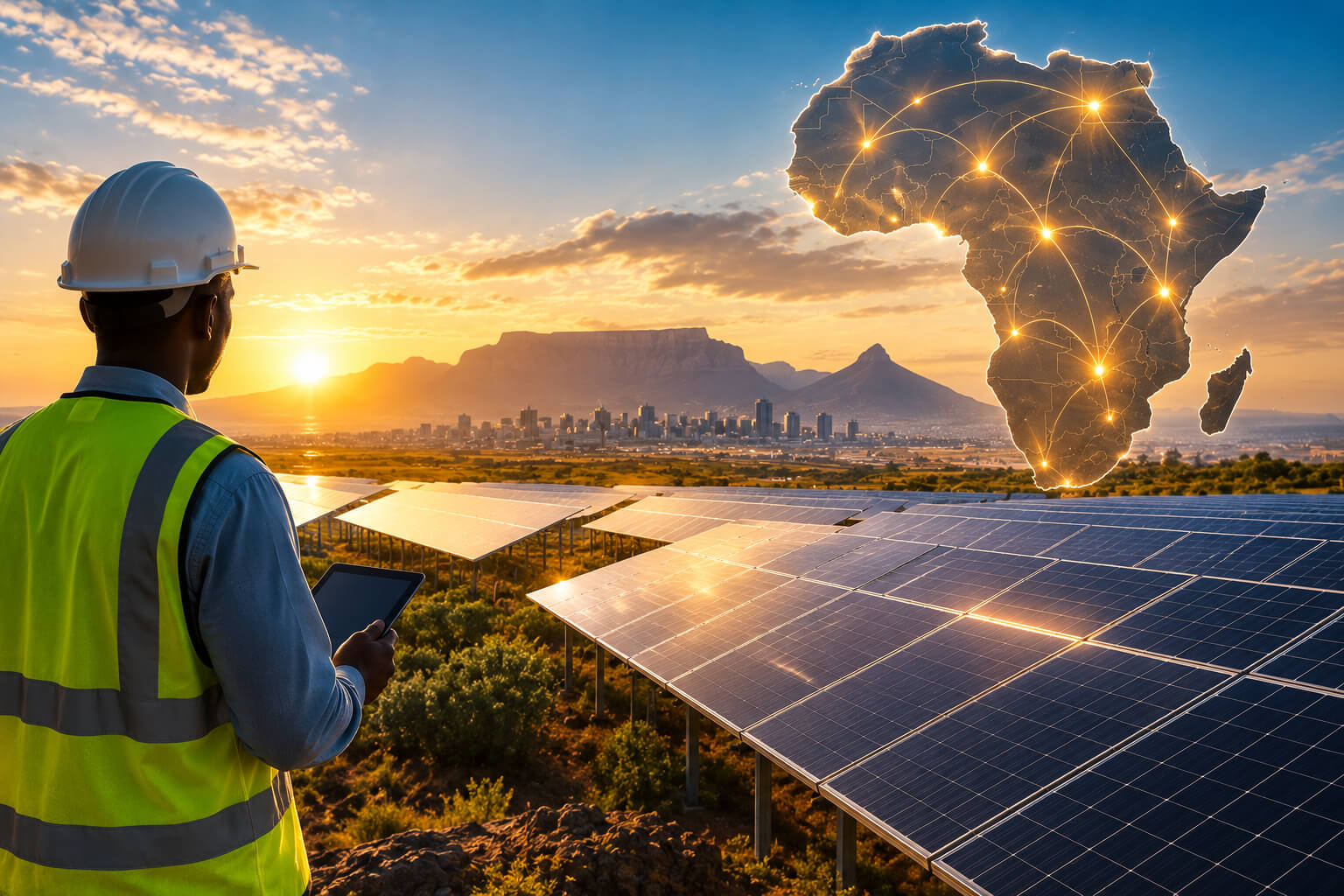
Africa’s commercial solar market has secured another injection of capital, this time through a financing structure designed around one of the region’s persistent clean-energy challenges: access to affordable, locally matched funding.
Developing World Markets has provided Spark Energy Services with an R80 million senior secured credit facility, equivalent to roughly US$5 million. Spark, a commercial and industrial clean-energy financing platform managed by Camco, plans to use the funding to support renewable energy projects for businesses, particularly in South Africa.
The size of the deal is only part of the story. The way the financing has been structured could prove just as important for companies trying to expand commercial solar across African markets.
Spark Secures R80 Million for Commercial Solar Projects
The new facility gives Spark additional capital to finance renewable energy systems for commercial and industrial customers. Rather than requiring businesses to fund the full cost of solar installations upfront, Spark works with local developers and helps finance renewable energy and energy-efficiency projects for qualifying customers.
This model can make solar more accessible to businesses that already see the value in reducing electricity costs but cannot justify tying up significant capital in equipment. Factories, farms, warehouses, retail businesses and other commercial users can adopt on-site renewable energy while spreading the financial burden over time.
Spark’s approach is built around removing the upfront cost barrier. The platform can provide financing for eligible renewable energy and energy-efficiency equipment, helping businesses shift toward cleaner power without taking on the full initial investment themselves.
Rand-Denominated Financing Reduces Currency Risk
One of the more notable aspects of the deal is that the facility is denominated in South African rand rather than US dollars or euros. That matters because many renewable energy projects in Africa generate revenue in local currencies while their financing obligations are often linked to foreign currencies.
When a local currency weakens, repayments on dollar-denominated debt can become much more expensive. That mismatch can undermine project economics even when the underlying solar installation is performing well.
By providing financing in rand, the facility aligns the debt more closely with the revenue generated by South African projects. Spark therefore avoids some of the foreign-exchange exposure that often complicates renewable energy financing in emerging markets.
It may look like a technical detail, but currency structure can determine whether a project remains commercially viable over the long term.
Commercial and Industrial Solar Is Gaining Ground in Africa
Commercial and industrial solar is becoming an increasingly important part of Africa’s energy transition. Unlike large utility-scale solar farms, these projects are usually installed directly at business premises such as factories, warehouses, farms, shopping centres and office complexes.
The electricity generated can reduce dependence on national grids, lower energy costs and provide businesses with more control over their power supply. In countries where outages and electricity-price increases remain common, that control has real commercial value.
Spark has been building its portfolio around this distributed model. Camco reported that Spark ended 2025 with around $28 million in assets under management and supported dozens of commercial and industrial businesses alongside development partners.
Its portfolio also included several megawatts of renewable capacity that were already operating or under construction. Individually, these projects may appear small compared with major solar farms, but collectively they can create a significant amount of distributed generation.
Spark Plans to Expand Its African Renewable Energy Portfolio
Spark’s longer-term ambitions extend well beyond its current project base. The company has been expanding its work with small and medium-sized commercial and industrial businesses while building partnerships across several African markets.
According to the original report, Spark aims to support more than 100 SME commercial and industrial businesses and reach approximately 85 MWp of operational renewable energy capacity by 2030.
The platform has also developed activity and partnerships in markets including South Africa, Kenya, Uganda, Ghana, Nigeria and Tanzania. That makes its financing model relevant beyond one national market.
For African SMEs, access to electricity is rarely just an environmental issue. Reliability, operating costs and predictable energy pricing directly affect profitability. Solar financing can therefore become a business decision as much as a sustainability decision.
Africa Still Faces a Major Clean-Energy Financing Gap
The R80 million facility will not close Africa’s energy investment gap on its own. The continent still requires significantly more capital to expand electricity access, build renewable energy infrastructure and reduce dependence on expensive or unreliable power systems.
The International Energy Agency estimates that hundreds of millions of people across Africa still lack access to electricity. Meeting universal access goals will require sustained investment over many years from governments, development institutions and private investors.
That makes smaller commercial financing transactions important. Africa’s energy transition will not be built only through billion-dollar infrastructure projects. It will also depend on thousands of smaller renewable energy installations deployed at businesses, schools, farms, hospitals and industrial sites.
Financing those projects at scale remains one of the biggest challenges.
Local-Currency Financing Could Unlock More Solar Investment
Local-currency financing may become an increasingly important tool for renewable energy developers across Africa. Currency volatility can quickly erase the financial benefits of an otherwise successful project when borrowers earn revenue locally but repay debt in dollars.
Matching project debt with local-currency income creates a more stable financial structure. It does not remove every risk, but it reduces one major source of uncertainty.
High interest rates, limited long-term capital and regulatory uncertainty still make renewable energy financing difficult in many African markets. Local-currency facilities can at least help reduce the pressure created by foreign-exchange movements.
That could encourage more developers and businesses to move forward with projects that might otherwise remain financially difficult.
Aggregated Solar Portfolios Could Attract More Investors
Another advantage of platforms such as Spark is their ability to combine multiple smaller renewable energy projects into a larger portfolio. Institutional investors may hesitate to finance individual rooftop solar installations because the transaction costs can be high relative to the size of each project.
A portfolio containing dozens of commercial installations creates a different proposition. Investors can gain exposure to a broader pool of assets rather than depending on a single project or customer.
This aggregation model can help bridge the gap between small distributed solar projects and larger sources of institutional capital. It can also give local developers access to financing that would be difficult to secure independently.
The result is a structure that could potentially be repeated across different markets and customer segments.
Solar Financing Is Becoming as Important as Solar Technology
Africa does not necessarily have a shortage of solar technology. Panels, batteries, inverters and energy-management systems are already widely available. The harder question is often how businesses will pay for them.
That is why financing models are becoming central to the next phase of renewable energy growth. Businesses may already want solar, but projects can stall when upfront costs, currency risk or financing terms make the investment unattractive.
The R80 million facility provided to Spark Energy Services addresses part of that problem. It gives the platform additional capital while reducing foreign-currency exposure for South African projects.
If similar local-currency structures become more common, commercial solar could become easier to finance across the continent.
For Africa’s energy transition, that may be where some of the most meaningful progress happens: not through one massive project, but through hundreds of businesses quietly generating more of their own power.
Sources
Africa Sustainability Matters — Spark Secures $5 Million Rand Facility for Commercial Solar in Africa
https://africasustainabilitymatters.com/spark-secures-5-million-rand-facility-for-commercial-solar-in-africa/
Camco — Spark Energy Services Annual Report 2025
https://impact.camco.fm/camco-annual-report-2025/spark
International Energy Agency — Financing Electricity Access in Africa
https://www.iea.org/reports/financing-electricity-access-in-africa
International Energy Agency — Pathway to Universal Access
https://www.iea.org/reports/financing-electricity-access-in-africa/pathway-to-universal-access